
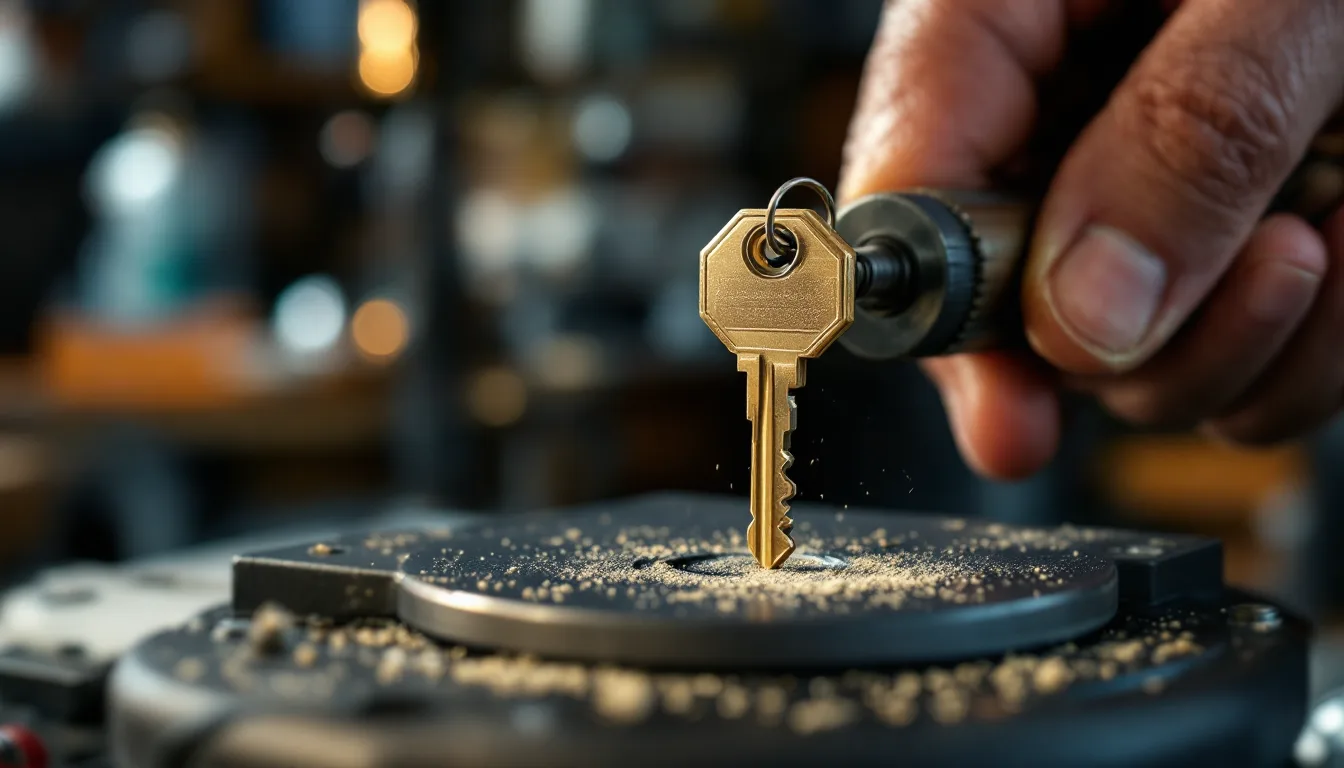
What does key duplication really involve for a View Park–Windsor Hills home?
On paper, copying a key is simple: a blank is cut to match the pattern of the original. In practice, the quality of the copy depends on the key you start with, the blank you cut it on, and the person running the machine. A copy made carelessly from a worn key will still go into the lock, but it may turn stiffly, wear the pins faster, or work only on a good day. We have been cutting keys since 1987, and the most common mistake we see is a spare that was copied from another copy, with small errors piling up each generation.
In View Park–Windsor Hills the situation often has a particular shape. This is a hillside community of 1920s–1940s homes, mostly single-family and owner-occupied, and many of them still carry original hardware. A household may have had the same front-door key for decades, passed between family members, with one or two spares stretched thin across a growing number of people who need to get in. Other households are on the opposite end: a new owner, an heir, or a family member who has just been handed one key to a house that needs five.
This page covers what we do when you need more keys: how we cut them, which keys we can and cannot copy, what changes the cost, and how it works for homes, offices and mailboxes in the 90043 and 90008 ZIP codes. If your real problem is that a key no longer works, or you do not know who has copies, we will say so and point you to the right service rather than just cutting another key.
Why do old keys and period hardware need extra care?
Many homes in the View Park historic district and the streets around it were built in the Spanish Colonial Revival and Mediterranean styles, and a good number still use original mortise locks, glass knobs and period hardware. Owners here often prefer to repair that hardware instead of replacing it, and we think that is a reasonable instinct when the lock is sound. It changes how we approach key copying, though.
Keys for older mortise locks are often a different shape from the flat, milled keys on a modern deadbolt. Some are heavier, some have unusual bows or bit shapes, and some have been filed or re-cut by hand over the years. Standard blanks do not always exist for them, and a key that has been hand-modified is a poor pattern to copy from because you would be copying its modifications too. If you have a key like this, bring the best original you have and, if possible, the lock itself or tell us which door it belongs to.
A few things we watch for with older keys:
- Worn bitting: a key used for decades loses material on its cuts. Copying the wear into a new key gives you a copy that works worse than the original did when it was new.
- Bent or twisted blades: a key that has been bent back and forth may need straightening before it can be copied accurately. Some are too fatigued to straighten safely.
- Hand-cut or one-off keys: when no matching blank is available, the honest answer may be to work from the lock side instead of the key side.
- Keys that already stick: if a key only works when you jiggle it, the problem may be the lock, not the key. Cutting a spare from a key that fights the lock just duplicates the frustration.
Locked out or need a locksmith now?
We answer around the clock, every day of the year.
Call (213) 577-1366How do we duplicate a key, step by step?
Our process is not complicated, but each step is there for a reason. Here is how a typical job goes, whether you walk into the storefront or we handle it by phone first.
- We look at the key and ask what it opens. A house key, a deadbolt key, a mailbox key and an office key can look alike and behave very differently.
- We check the key for restrictions. Some keys are stamped or have a keyway that is controlled by the manufacturer, which means we need to confirm authorization before cutting. We explain this before work starts, not after.
- We choose the correct blank. The keyway, length and brand profile all have to match. A blank that is close is not the same as a blank that is right.
- We inspect the original for wear or bends. If the pattern is poor, we say so and discuss cutting by the lock's code or from the lock itself instead.
- We cut the copy and remove the burrs left by the cutting wheel. Burrs are small, but they catch inside a lock and cause grit and wear.
- We test the new key in the lock when the lock is available, and we compare it with the original. A copy that looks right but has not been tried in the cylinder is not finished.
- We explain which key is which. If you are ordering several, we help you tell them apart so a good copy does not get mixed up with the original.
Which keys can we copy?
Most keys can be copied. The difference between the easy ones and the ones that need more thought is mainly about the keyway and who controls it. Here is how it breaks down.
- House key copy and spare house key: standard residential keys for front doors, back doors and side entrances are the most routine jobs we handle.
- Duplicate deadbolt key: deadbolts often use a different keyway from the knob lock on the same door. We copy whichever key you hand us, and we can check that you have the right pair.
- Apartment key copy: building keys are often handed out by a landlord or property manager. If your lease says you cannot copy a key, follow that and speak with management. We will not guess at what is allowed.
- Office key duplication and commercial key duplication: office, suite and storage keys. For larger offices, a master key system may be better than collecting dozens of loose copies; we cover that under master key systems.
- Mailbox key duplication: mailbox keys are small, are often a different style from the rest of your keys, and sometimes the lock itself is the real issue. If the box lock is worn or the key is lost, see mailbox lock replacement.
- High security key duplication: higher-security cylinders often use more complex keys. We handle many of them, but some require the manufacturer's authorization, a key card, or a proof-of-ownership process before a copy can be cut. More on those cylinders is on our high-security locks page.
- Restricted key duplication: restricted keyways exist so that copies cannot be made at any hardware counter. We can copy these only when the authorization is in place, and we will tell you plainly if it is not.
Locked out or need a locksmith now?
We answer around the clock, every day of the year.
Call (213) 577-1366What about car keys and 'Do Not Duplicate' stamps?
Car keys are a separate job. A metal blade cut to match is not the same as a key that starts the car, and a vehicle with a chip in the key needs more than cutting. We confirm what a particular vehicle needs by VIN and in person rather than guessing from the make and model. If that is what you need, start with transponder key programming; we will not pretend a basic copy covers it.
As for 'Do Not Duplicate' stamps, those words on a key are a request, not a physical lock on the key. The stamp does not stop a machine from cutting it. What matters to us is whether the key belongs to you or you are authorized to copy it. If a key is stamped and you are the owner or the property manager, tell us that up front. If we cannot tell whether a copy is appropriate, we may ask for more information before cutting.
What affects the cost of duplicate keys?
We do not quote numbers on a web page because the price depends on the specifics of your key. What we can do is tell you honestly what moves it up or down, so the figure we give you on the phone makes sense.
The factors that matter most:
- Key type: a standard residential key is the lighter-cost job. High-security, restricted and unusual keys take more time and sometimes more expensive blanks.
- Blank availability: a common blank is simple. A rare or discontinued blank for period hardware may need to be sourced or a key made another way.
- Condition of the original: a clean, accurate key is easier to copy than one that needs straightening or correction first.
- Authorization steps: restricted keys involve paperwork or confirmation that takes time, and that effort is part of the job.
- Quantity: cutting several keys in one visit is usually the more economical route than coming back one at a time.
- Location: a visit to the storefront on Wilshire Blvd is typically the lighter-cost route for a simple copy. If you want us to come to you, travel is a factor, and View Park–Windsor Hills is about 11 miles from our base.
- Time of day: we answer the phone at any hour. An after-hours call-out costs more to run than a daytime visit, and we will tell you that before we head out.
Key duplication in View Park, Windsor Hills and the nearby neighborhoods
Key work here follows the housing. In View Park and Windsor Hills, the homes are mostly single-family and owner-occupied, built in the 1920s–1940s, and many have original mortise locks and period hardware. That means the keys we see are often old, often few in number, and often the only link between a household and the front door. Making a clean spare from one of those before it wears out or goes missing is one of the more sensible bits of maintenance an owner can do. If a lock itself has become stiff, that is a job for lock repair, and our advice is to fix the lock before you copy a key that has been fighting it.
One scenario comes up repeatedly on the View Park side: a home changes hands, or is inherited, inside the historic district. The new owner or the family often holds one or two keys and has no idea how many others are out there. Our usual advice is to copy what you need for the people who live there, and then decide whether the unknown copies are a risk. If they are, rekeying changes the lock to a new key and makes the old copies useless. That is different from key duplication, and we will explain which one fits.
Hillside lots add another wrinkle. Terraced properties often have gate and side-entrance locks that are separate from the front door, and they may be keyed differently. Households end up with a ring of keys for a gate, a side door, a garage entrance and the front, and they often copy them in a hurry. We suggest labeling each key at the time of copying, and if the gate lock is the weak point, see gate lock repair.
Customers also come from the surrounding streets: Baldwin Hills, Baldwin Vista, Hyde Park and the Crenshaw District, all in the City of Los Angeles but close to the 90043 and 90008 ZIP codes we serve here. Some people work near the Slauson Avenue and Overhill Drive commercial corner and need office or shop keys duplicated; others live near the View Park Bebe Moore Campbell Library or Windsor Hills Math Science Aerospace Magnet school and need a spare for a family member. Climate is mild on the hilltop, with marine-layer mornings and only modest seasonal swelling in older wood doors, so a key that sticks is rarely a weather issue here. It is more likely to be a worn key or a tired lock.
Locked out or need a locksmith now?
We answer around the clock, every day of the year.
Call (213) 577-1366Should we come to you, or should you come to the storefront?
For a basic house key copy, the storefront at 10740 Wilshire Blvd in Westwood is the simplest option. You hand over the key, we cut it, and you test it. For many people this is also the more economical route.
Mobile key duplication makes sense in a few situations: you cannot leave the property, the lock needs to be checked on site, the key is for a period mortise lock and the cut should be matched against the lock itself, or you need a handful of keys for several doors in one visit. We can bring the work to you through our mobile service, and we explain what can be done on site and what is better done at the shop. Our mobile locksmith page describes how that works generally.
Because we answer the phone 24 hours a day, 7 days a week, you can always ask. Tell us what the key opens, whether you have the original, and where you are, and we will say honestly which route fits.
Why call Wilshire Lock & Key for key duplication?
We are a locksmith, not a dispatch service. When you call (213) 577-1366, you reach our company, not a call center that passes the job to whoever is closest. The people who talk to you are the people who stand behind the work.
Here is what we can honestly say about how we operate:
- In business since 1987. Key duplication is a basic part of the trade, and we have done it for a long time.
- A storefront and mobile vans. Simple copies can be done at 10740 Wilshire Blvd; jobs that need us on site can be handled in the field.
- One company, no middlemen. You are dealing with us from the first call to the finished key.
- David's oversight. David is the owner and lead technician, and he is the person who sets how we handle the awkward jobs: old mortise keys, restricted keyways, and cases where we recommend not cutting at all.
- Honest limits. If a key cannot be copied without authorization, or a copy will not be good enough, we say so.
A note on checking any locksmith's credentials
California requires locksmith companies to hold a license from the Bureau of Security and Investigative Services (BSIS), known as an LCO license. Whoever you hire for keys or any other lock work, ask for it and check it. It is a fair question, and a reputable company will not mind answering it.
If you would like to talk through a key job before you commit, you can contact us or call the number at the top of this page. We would rather you ask a question than cut the wrong key.
Frequently asked questions
Can you copy a key for an old mortise lock in a 1930s home?
Often, yes, but it depends on the key. Many older mortise keys use unusual shapes, and some have been hand-filed over the years. We look at the key and ask about the lock. If a matching blank is available and the original is in good shape, we can cut it. If it is not, we may work from the lock rather than from a worn key. Bring the best original you have.
Is a copy of a copy a problem?
It can be. Every copy carries the small errors of the one before it, and those add up. A spare cut from a spare may work, but it may also stick or wear the lock. If you have the original, use that as the pattern. If you only have copies, tell us, and we will check how well the key works before making more.
Can you duplicate a restricted or high-security key?
Sometimes. Restricted keyways are designed so that copies are only cut with authorization from the owner or manufacturer. We can handle many of them when that authorization is in place, and we explain what we need before we begin. If it is not possible without the proper documentation, we will tell you plainly instead of cutting something that may not work.
Can you copy a key marked 'Do Not Duplicate'?
That stamp is a request, not a physical barrier. What matters to us is whether you are the owner or authorized to have the copy. If you are, tell us and we will talk through it. If we cannot tell whether a copy is appropriate, we may ask for more information, and for an apartment key you may need to check with your landlord first.
Do you make mailbox key copies?
Yes. Mailbox keys are small and usually a different style from your house keys, so bring the key with you. If the key is lost or the box lock is worn, a copy may not be the right fix, and replacing the lock may make more sense. We will tell you which applies.
How do I know a new copy will actually work?
We test the key in the lock whenever the lock is available, and we compare it with the original. We also remove the burrs left by cutting, because those cause sticking. If you take a copy home and it does not work smoothly, bring it back and we will look at it.
Should I copy my keys or rekey the lock after buying or inheriting a home?
It depends on what you do not know. If you have all the keys and know who has them, copying is enough. If you do not know how many copies exist, rekeying makes every old key stop working. Many owners do both: rekey, then cut the number of keys they need from the new key.
What does it cost to duplicate a key?
We do not publish numbers because the cost depends on the key. A standard residential key is the lighter-cost job. Restricted, high-security or unusual keys cost more because of the blank and the authorization steps. Quantity, whether you come to us or we come to you, and the time of day also play a part. Call (213) 577-1366 and describe the key, and we will explain what applies.
Can you come to my house to make keys?
We offer mobile service, and for some jobs it makes sense, especially for period mortise locks, several doors at once, or when you cannot leave the property. For a simple copy, the storefront in Westwood is usually the more economical route. Call us and we will say which fits.
More locksmith help in View Park–Windsor Hills
Key Duplication near View Park–Windsor Hills
Reviewed by David, Owner & Lead Technician, Wilshire Lock & Key — in the locksmith trade since 1987.
Last updated 2026-10-11.