
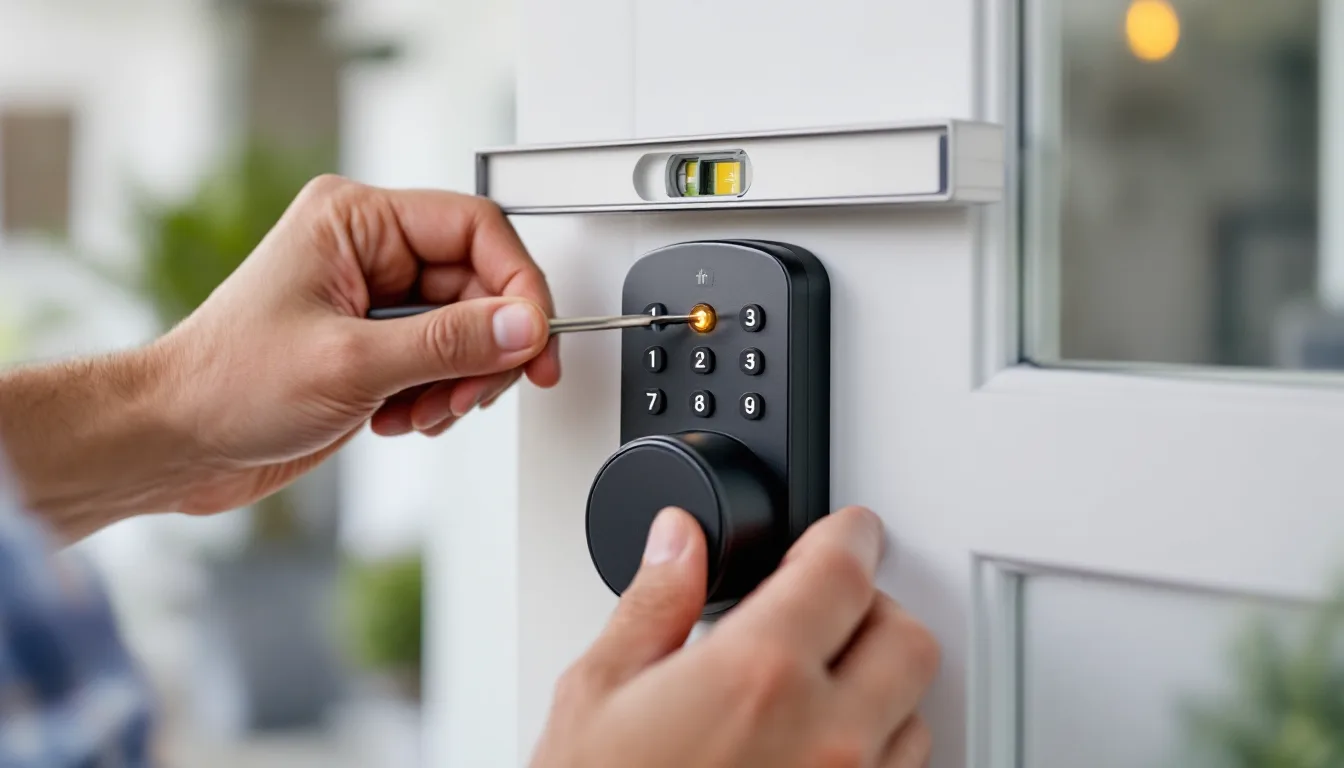
What smart lock installation really involves
A smart lock is two jobs wearing one box. The first is a mechanical job: a deadbolt or lever has to sit square in the door, throw fully into the strike, and turn without binding. The second is an electronic job: a keypad, motor, radio, and battery have to be configured, paired, and tested so the lock does what you expect when you are standing outside with your hands full.
Most failed smart lock installs come from treating it as only the second job. People pair the app, see a green light, and assume the work is done. Then the bolt rubs the strike plate, the motor strains, the batteries drain early, and the lock starts throwing errors. A smart lock puts more demand on the door and the hardware around it than a plain key lock does, because a small motor is doing the work your wrist used to do.
This page explains how we approach the whole job, including the parts that rarely appear in the quick-start guide. If you want to compare it against a basic hardware swap, our lock installation page covers non-electronic locks.
Why people call a locksmith for a smart lock
The calls we get tend to fall into a few patterns. Knowing which one you are in helps us bring the right parts and tools to the door.
- You bought a keypad or app-controlled lock and want it fitted properly, set up, and tested rather than fighting it yourself.
- You are replacing an older smart lock that has stopped responding, locked itself in a strange state, or no longer pairs with your phone.
- You manage a rental or a short-term stay property and want codes you can change between occupants without handing out physical keys.
- A family member struggles with small keys, and a keypad or phone-based entry would make daily life easier.
- You were locked out because the batteries died or the app lost its connection, and you now want the lock checked and set up with a sensible backup.
- You moved into a place with a smart lock that the previous owner configured, and you need it reset so only you have access.
How we install a smart lock, step by step
Every door is a little different, but the sequence we follow is consistent. Skipping steps is where problems begin.
- Talk through what you want. We ask how you plan to use the lock: keypad only, phone control, remote access, shared codes, or integration with a hub you already own. That decides which hardware makes sense.
- Inspect the door and the old lock. We check the door's thickness, the bore hole size, the backset, the edge condition, and whether the door has swollen, sagged, or been patched before. A door that does not close cleanly will not run a motorized bolt cleanly.
- Remove the existing hardware. We take out the old deadbolt or handle set, check the latch and strike for wear, and look for bore damage or loose mounting.
- Fix the mechanical basics first. If the strike plate is misaligned, the latch is dragging, or the screws are short, we correct that before mounting anything electronic. This is the step most often skipped.
- Mount the lock body and the interior assembly. We seat the bolt, run any cable between the exterior and interior sections without pinching it, and tighten to the manufacturer's recommended fit rather than overtightening, which can bind the motor.
- Install batteries and run the manual action. Before pairing anything, we test that the bolt extends and retracts freely by hand and by motor, with the door open and then closed.
- Configure the lock. We set the master code, add the user codes you want, set auto-lock behavior if you want it, and adjust volume and settings. We also set up the manual key override if the lock has one.
- Pair with your phone, Wi-Fi, or hub. We connect the lock to the app or system you use, test the connection from inside and outside the door, and confirm remote commands actually reach the lock if that matters to you.
- Test the full routine with you. We lock and unlock from every method together, door open and door shut, so you see how it behaves. We show you how to change codes, replace batteries, and use the physical key.
Locked out or need a locksmith now?
We answer around the clock, every day of the year.
Call (213) 577-1366What a professional checks that the box instructions skip
The manufacturer's instructions assume a perfectly prepared door. Real doors rarely are, particularly in older homes where wood has moved over decades. A few things we check every time:
- Bolt alignment under load. A deadbolt that slides by hand can still drag once the door is shut and the weatherstripping is pushing back. We test with the door closed.
- Backset and bore. Doors are commonly drilled for one of two standard backset distances, and some are drilled slightly off. We confirm the lock fits without forcing it or leaving a gap.
- Door and frame condition. Soft or split wood at the strike, loose hinges, or a door that rubs the jamb will put extra strain on a motor.
- Cable routing. Wires between the two halves of the lock can be pinched by an overtightened mounting plate, which causes intermittent faults that are maddening to trace later.
- Battery orientation and contact. A battery slightly out of seat is a classic cause of a lock that works only some of the time.
- Wireless signal at the door. A strong signal in the living room says little about the front step. We test where the lock actually sits.
- Override access. We make sure the physical key or emergency method works, because that is what you will rely on when a battery dies.
How the type of smart lock changes the job
Smart lock is a broad label. The hardware underneath varies, and the variation changes the labor, the setup, and what can go wrong.
- Keypad deadbolts replace your existing deadbolt entirely. These are straightforward on a standard door but still need a good bolt, strike, and alignment. They work without a phone, which many households prefer.
- Retrofit smart units keep your existing exterior deadbolt and key, and replace only the interior thumb-turn with a motorized piece. They are less intrusive, which is useful for renters or anyone who wants to keep matching keys, but they depend on the existing deadbolt turning easily.
- Smart lever handles are for interior doors and certain entry doors that use a latch rather than a deadbolt. A latch alone is not a high-security setup for an exterior door, so we usually talk through adding a deadbolt as well.
- Bluetooth locks talk to your phone when you are near the door. They are simple and do not need your home Wi-Fi, but they do not give you remote control away from home unless paired with a bridge.
- Wi-Fi locks connect to your network directly or through a bridge, allowing remote lock and unlock, code changes, and activity logs. They use more battery and depend on a stable network.
- Hub-based locks use protocols built for home automation and pair with a hub you already own. Setup is more involved, and we configure them with your hub's requirements in mind.
- Biometric locks add fingerprint reading. They need more careful setup, enrollment, and testing, especially for children and for people with worn fingertips.
- Multipoint and heavier doors, such as wide entry doors or those with multiple latches, may need specific hardware, and some will not accept a standard smart deadbolt at all.
Locked out or need a locksmith now?
We answer around the clock, every day of the year.
Call (213) 577-1366Wi-Fi, Bluetooth, and hubs: choosing connectivity that will hold up
Connectivity is the part of a smart lock most likely to cause trouble after installation, so it is worth choosing deliberately. If you only want to open the door with a code or your phone nearby, a keypad or Bluetooth lock is the simpler path, with fewer things to fail. If you need to let a guest in while you are away, check on the door from elsewhere, or see who came and went, you need Wi-Fi or a bridge.
We look at the signal where the lock actually lives. Thick walls, metal screen doors, security doors, and distance from the router all affect it. Sometimes the answer is a bridge placed closer to the door, or a change in where the router or hub sits. We would rather tell you that before installing than leave you with a lock that drops offline every evening.
We also talk through the account side: the app login, who has admin access, and what happens if you change your phone. A lock tied to an account you cannot recover is a lock you will eventually pay to reset, so we help you set up recovery details at the door.
Smart lock repair, troubleshooting, and replacement
Plenty of calls are about a smart lock that already exists. The symptoms usually point to a short list of causes, and we work through them in order from simplest to most involved.
- The lock is slow, buzzes, or does not fully throw the bolt. This is often alignment or door movement, sometimes weak batteries, and occasionally a worn motor.
- The keypad is unresponsive or only some buttons work. Worn contacts, moisture, or a failing keypad assembly are common causes.
- The app says offline or will not pair. Router changes, a new phone, firmware problems, or a distant bridge are likely suspects.
- Codes stop working or the lock forgets settings. This can point to a low battery, a corrupted configuration, or a lock that needs a factory reset and clean setup.
- The lock was fine until the door was repainted, rehung, or weatherstripped. The door changed, and the lock is reacting to it.
- The lock locks itself or fails to auto-lock. Settings, latch sensors, or alignment may be off.
When repair makes sense and when replacement is the better call
If the problem is alignment, batteries, settings, or a connection issue, repair is the sensible route and usually the more economical one. If the motor is failing, the electronics are damaged, the lock is physically worn out, or the manufacturer no longer supports the app it depends on, replacement tends to be the honest answer. We will tell you which one we think it is and why. If the underlying issue is a worn mechanical lock rather than an electronic fault, our lock repair service may be the better fit.
Locked out or need a locksmith now?
We answer around the clock, every day of the year.
Call (213) 577-1366What this service cannot fix
Honesty about limits saves you money. A smart lock adds convenience and control. It does not turn a weak door into a strong one. If the frame is splintered, the strike is held by short screws into soft wood, or the door itself is hollow and damaged, the electronics will not change how it holds up. Those issues need to be fixed first or alongside.
Some situations call for a different service entirely:
- If you want a stronger physical lock without electronics, a standard deadbolt installation is often the right call, and it removes batteries and apps from the equation.
- If you only want to stop an old key from working, rekeying handles that without new hardware.
- If the door will not close properly or the frame is damaged, that carpentry-adjacent problem has to be dealt with before a motorized lock goes on.
- If your door is an unusual type, such as certain glass, aluminum, or older specialty doors, a standard smart deadbolt may not fit, and we will say so rather than force it.
- If a lock is cloud-locked to a previous owner's account, we can sometimes help with physical access and reset, but we cannot bypass an account lock that the manufacturer controls.
What affects the price of a smart lock installation?
We do not quote numbers on a web page, because the honest answer depends on the door and the lock. These are the factors that move the cost up or down:
- The lock itself. Hardware varies widely by type and features, and you can supply your own or have us recommend one.
- Whether it is a new install or a swap. Replacing an existing deadbolt of the same size is usually simpler than preparing a door that has never held one.
- Door condition. Misaligned latches, damaged bores, loose hinges, and worn strikes add work, but they also protect the lock.
- Connectivity setup. A basic keypad is quicker than a Wi-Fi lock that needs a bridge, account setup, and hub pairing.
- Number of locks and users. Several doors, or many codes and users to configure, adds time.
- Time of day and location. After-hours and distant calls cost differently than daytime calls near our storefront.
- Repair versus replacement. Diagnosing and fixing an existing lock has a different scope than installing a new one.
Why call Wilshire Lock & Key for smart locks
We have been a working locksmith company since 1987, which means we learned on mechanical locks and understand what a motor and keypad depend on. That background matters, because most smart lock problems turn out to be mechanical problems wearing an electronic costume.
We are one company. We have a storefront at 10740 Wilshire Blvd in Westwood and mobile vans that come to you, and the person who answers your call is not a dispatch middleman reselling the job to whoever is closest. David, the owner and lead technician, oversees the work.
We answer the phone 24 hours a day, 7 days a week, year-round, at (213) 577-1366. If a lock fails at night, you reach us, not a call center.
One more thing we encourage: California requires locksmith companies to hold a BSIS LCO license, and you should ask any locksmith, including us, for it before they start work. It is a reasonable question and a good filter.
Locked out or need a locksmith now?
We answer around the clock, every day of the year.
Call (213) 577-1366Where we install smart locks
We serve 140 cities across Los Angeles and Ventura counties, working out of our Westwood storefront and our mobile vans. You can see the full list on our locations page.
If you want something specific to your area, we have dedicated pages for smart lock installation in Los Angeles, Santa Monica, and Pasadena, among others. Those pages focus on local conditions, and this one focuses on the work itself. If you are unsure whether we cover your address, call (213) 577-1366 and we will tell you plainly.
Frequently asked questions
Can you install a smart lock I already bought?
Yes, in most cases. Bring or tell us the make and model and we will check that it fits your door type, backset, and thickness before starting. If it does not suit your door, we will say so and suggest what would.
Do smart locks work during a power or internet outage?
Most run on batteries in the lock itself, so a power outage at home does not stop keypad or physical key entry. Remote features through Wi-Fi depend on your internet connection and will not work if it is down. We set up and test a backup method with you.
What happens if the batteries die and I am locked out?
Many locks give a warning before the batteries fail, and many have a backup key or an external contact point for emergency power. If you are already locked out, call (213) 577-1366 and we will help you get in and then check why it happened.
Is a smart lock less secure than a regular deadbolt?
Not inherently. A smart lock is only as strong as its bolt, door, and frame, plus how well the codes and accounts are managed. We focus on the mechanical fit and on sensible code and account practices, and we are candid when a plain deadbolt is the better choice for your situation.
Can I keep my existing key and just add smart features?
Often yes. Retrofit units replace only the interior part of the lock and leave your exterior deadbolt and key in place. They depend on your existing deadbolt turning smoothly, so we check it first.
Can you change the codes or reset a smart lock from the previous owner?
Usually yes. We can reset the lock, clear old users, and set new codes so only you have access. If a lock is tied to a previous owner's online account, the manufacturer may need to be involved, and we will tell you what to expect.
Do you handle smart lock repair as well as installation?
Yes. We troubleshoot slow motors, unresponsive keypads, pairing failures, and lost settings, and we fix or replace the lock depending on what we find. Often the cause is alignment, batteries, or connectivity rather than a failed lock.
Will you recommend a particular brand?
We recommend by fit and use, not by logo. The right lock depends on your door, whether you want remote access, how many people use it, and what you already have at home. We will explain the trade-offs and let you decide.
Can you install smart locks at several doors or at a rental property?
Yes. We can match hardware across multiple doors, set up shared or temporary codes, and configure the system so it is easy to manage between occupants. Call (213) 577-1366 and tell us how many doors and what you need to control.
Smart Lock Installation near you
Related services
Reviewed by David, Owner & Lead Technician, Wilshire Lock & Key — in the locksmith trade since 1987.
Last updated 2026-10-12.