
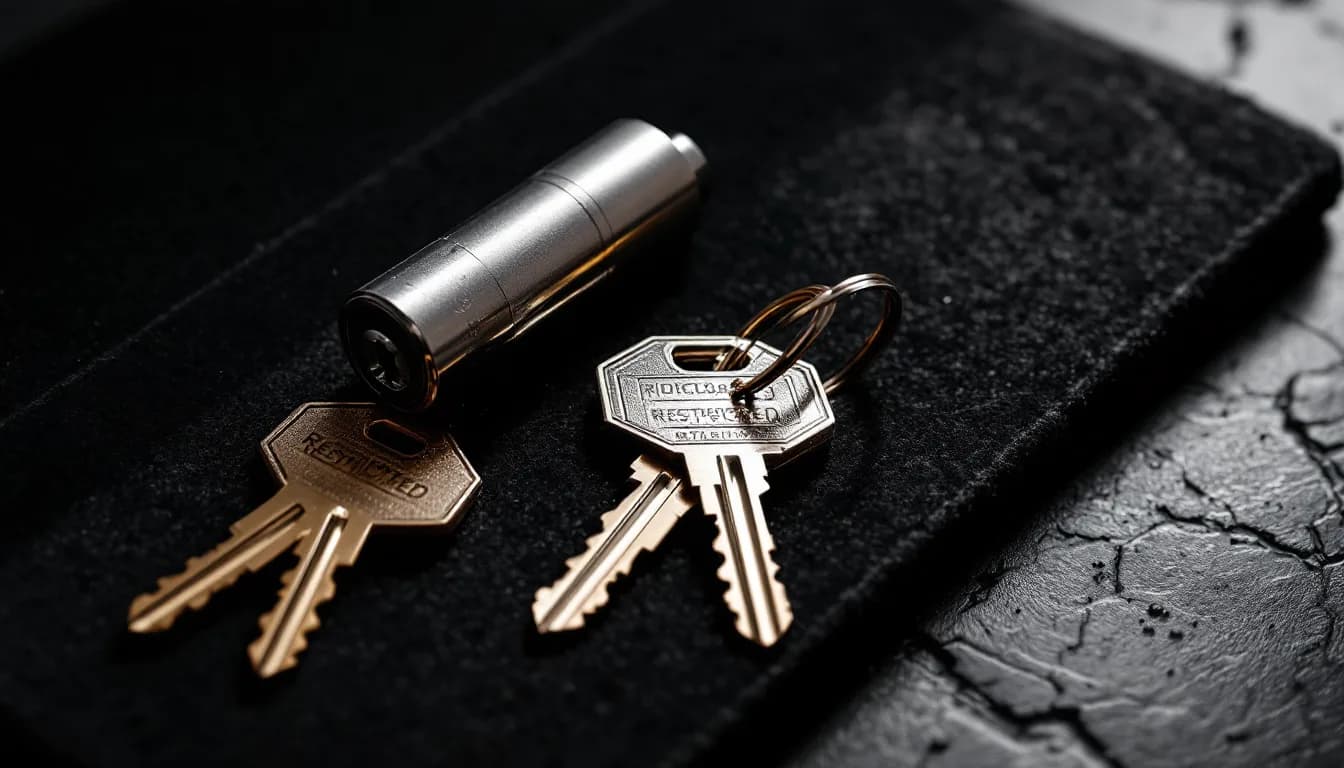
What counts as a high security lock, and what doesn't
The phrase gets used loosely. A lock on a hardware store shelf can carry those words on the box and still be a standard pin tumbler cylinder with a nicer finish. When we use the term, we mean a lock built so the common quiet attacks are meaningfully harder: picking, bumping, and unauthorized key copying. Often forced entry by drilling or snapping the cylinder is slowed down as well.
Three things make up the package. The first is the cylinder, the part your key turns, which is where pick and bump resistance live. The second is key control: a restricted keyway means blanks are not sold over the counter and copies require authorization from whoever holds the key records. The third is everything around the cylinder, meaning the deadbolt body, the strike plate, the screws, the frame and the door itself.
A very good cylinder in a weak door is a good part in a bad system. That is why a high security job with us starts with the whole door, not just the lock.
Why people call for high security locks
Almost nobody wakes up wanting a better cylinder for its own sake. There is usually a reason, and the reason shapes the job. These are the situations that bring most of the calls:
- You moved into a home or took over a business space and have no idea how many keys exist or who holds them.
- A former roommate, contractor, property manager, tenant or employee kept a key, or you cannot be sure they returned every copy.
- There was a break-in or an attempted one, and you can see scratches, drill marks or a damaged cylinder face.
- You manage several doors or units and want a keying system where the right people open the right doors and copies cannot be made casually.
- You keep valuables, records, equipment or a home office behind the door and want something better than the builder-grade hardware that came with it.
- You read about lock bumping or picking and want to know whether your current lock is a soft target.
- A lease, association rule or insurance paperwork calls for a particular grade of hardware. Read the exact wording and bring it to us, because the details matter.
How a high security lock actually resists attack
A standard pin tumbler cylinder relies on a row of spring-loaded pins that must line up at the shear line. That simple design is what makes it easy to pick and easy to bump. High security cylinders add layers so that lining up the pins is no longer the whole story.
Pick resistance usually comes from tighter manufacturing tolerances and special pins, such as spool or serrated shapes that give false feedback to a pick. Many designs add a second locking element, such as a sidebar, rotating discs or a magnetic component, that has to be satisfied separately from the pin stack. Pick tools that only manipulate pins never touch that second mechanism.
Bump resistance follows the same logic. A bump key works by transferring a sharp impact to the pins so they jump momentarily. When another element controls the plug, the jump alone does not open the lock.
Drilling and snapping are different attacks. Better cylinders use hardened steel inserts where a drill would go and shaped break points so that a forced snap does not leave the locking mechanism exposed. Note the word better: none of this is absolute.
We will tell you plainly that no lock is unpickable and none is unbreakable. High security means an intruder needs more skill, more time, more noise and more specialized tools, and that changes the odds a great deal. When you compare products, ask what a lock is certified to under independent standards such as UL 437 for pick, drill and tool resistance of key locks, and ANSI/BHMA grades for overall hardware strength. What the packaging says is not the same thing.
Locked out or need a locksmith now?
We answer around the clock, every day of the year.
Call (213) 577-1366How we install or replace a high security lock, step by step
Every door is a little different, so the order shifts, but the work follows this outline. The point of the sequence is that the lock gets chosen for your door, not forced onto it.
- We talk through why you are calling: who has had keys, what you are protecting, how many people need access, and whether anything was damaged or attempted.
- We inspect the door and frame. That means door thickness, bore sizes, backset, edge preparation, the condition of the strike plate, the hinges, how the door closes, and whether the frame can take the load of a stronger bolt.
- We choose the cylinder and the level of key control together with you, including whether keys should be keyed alike across several doors or kept separate.
- We remove the old hardware and look at what it was hiding: worn bores, splintered wood around the bolt, loose strike screws, or signs of past forced-entry attempts.
- We fit the new deadbolt or cylinder, correct any door prep that is off, and set the strike so the bolt throws fully into reinforced framing. Where it makes sense, we use longer screws that reach the stud rather than just the trim.
- We issue the keys and test every one repeatedly, with the door open and closed, from both sides. The bolt should move freely with no force, and the door should latch without lifting or pushing.
- We walk you through it. You learn how restricted keys are ordered, where any key card or authorization record should be kept, and what to do if a key goes missing.
Hardware and key variations that change the job
High security is not one product, and the version you need depends on the door in front of us. These are the variations that most often change what the work looks like:
- Cylinder swap versus full deadbolt replacement. If your existing deadbolt body is sound, we can often upgrade the cylinder alone. If the body is worn, low-grade or badly fitted, replacing the whole unit is the better route.
- Single-cylinder versus double-cylinder deadbolts. A key on both sides resists reach-through entry near glass but can trap people inside in an emergency. Many buildings restrict this, so we talk through safe egress before recommending it.
- Mortise locks on older doors. These have a deep pocket cut into the door edge, and the cylinder is a separate piece. Upgrading the cylinder is possible, but replacement parts have to match the mortise body.
- Commercial and storefront doors. Narrow aluminum stiles, glass doors, rim locks, panic hardware and fire-rated doors each limit what can be installed, and some have code requirements we work around instead of ignoring.
- Keyed-alike and master-keyed systems. Several doors can open with one key, or a master can sit above individual keys. Restricted keyways make it harder for those keys to spread.
- Padlocks and hasps. High security padlocks exist, but the hasp, chain or door they attach to usually decides how secure the setup really is.
- Electronic and smart locks. These can sit alongside a high security cylinder for the mechanical override. A smart lock is a different decision from a pick-resistant cylinder, and we explain the tradeoffs rather than blending them.
Locked out or need a locksmith now?
We answer around the clock, every day of the year.
Call (213) 577-1366What about vehicles and other keyed items?
This page is about door and building locks. Car keys are a separate field with transponder chips, remote functions and programming that vary by make, model and year. We do not quote vehicle chip or programming details from a generic chart. We confirm what a specific vehicle needs by VIN and in person, and if a particular vehicle can only be handled by the dealer, we will tell you that honestly instead of promising something we cannot do.
The same goes for odd cases such as cabinets, file drawers or older specialty locks. Bring the item or a clear photo, and we will say whether a high security upgrade makes sense or whether a different fix is the more economical route.
What a high security lock can't fix
Part of doing this since 1987 is knowing when the expensive answer is not the right one. A restricted cylinder does nothing about a hollow or damaged door, a split frame, a loose strike plate, or an unlocked window beside the entry. If the door and frame are weak, they should be strengthened first or alongside the lock.
It also will not help if the problem is someone who legitimately holds a key. If your only concern is lost or unreturned keys, rekeying the lock changes which key works without replacing hardware, and it is usually the more economical route. If your door has no real bolt at all, a solid deadbolt installation comes before any conversation about cylinders.
And if what you are protecting is cash, documents, firearms or irreplaceable items, a better door lock only guards the way in. A safe locksmith deals with the thing itself.
One more honest limit: restricted key systems depend on the manufacturer's records. Extra keys may need your authorization card, ID or paperwork, and ordering can take longer than copying a regular key at a hardware store. That is the system doing what it was designed to do, but you should plan for it.
What affects the price of high security lock work
Quotes vary a lot because the jobs vary a lot. We will not throw out a number before we know the situation, but we can tell you what moves the cost, and our pricing page explains how we approach estimates.
- Whether the work is a cylinder upgrade alone or a full deadbolt or lockset replacement.
- The level of key control: standard keyways with higher pick resistance, or a fully restricted system with documented authorization.
- How many doors are involved and whether they are keyed alike or on a master system.
- The condition of the door and frame, since repairs to the bore, edge or strike can add work.
- Commercial versus residential hardware, including fire-rated or glass doors.
- How many keys you need cut and issued at the time.
- The hour and location of the call. Emergency and after-hours work is different from a scheduled visit.
- Parts availability for the specific cylinder or mortise body that suits your door.
Locked out or need a locksmith now?
We answer around the clock, every day of the year.
Call (213) 577-1366Why call Wilshire Lock & Key
We have been in business since 1987, and that history shows up in small ways: we recognize older hardware, we know which fixes hold and which cause callbacks, and we are comfortable telling you when you do not need the product you called about.
We run a real storefront at 10740 Wilshire Blvd in Westwood and send mobile vans to customers. When a part or a key needs a bench, we have one. When a door needs work on site, the van comes to you.
You get one company, not a dispatch middleman. The person who answers the phone at (213) 577-1366, any hour of any day, works for the shop that does the job. David, the owner and lead technician, oversees the work.
A last point on trust: California requires locksmith companies to hold a license from the Bureau of Security and Investigative Services, known as a BSIS LCO license. Ask any locksmith, including us, for that license information before work begins, and be wary of anyone who hesitates or cannot give it to you.
Where we do this work
We serve 140 cities across Los Angeles and Ventura counties, from dense apartment corridors to hillside homes and commercial strips. The craft in this page is the same everywhere, but doors and buildings differ from place to place, so we keep a page for each area. You can browse the full list on our locations page.
If you are in the city of Los Angeles itself, see our high security locks in Los Angeles page. We also have dedicated pages for Beverly Hills and Pasadena, among many others.
If you are not sure whether we cover your address, call (213) 577-1366 and ask. We will tell you straight.
Frequently asked questions
Can a high security lock still be picked?
In theory, any mechanical lock can be defeated by someone with enough skill, time and the right tools. High security cylinders raise that bar considerably by adding extra locking elements, tighter tolerances and special pins, so common picking techniques stop working. The realistic goal is to make your door a much harder target than the one next to it.
Is lock bumping a real concern for home locks?
Yes. Bump keys exploit the simple pin design in standard cylinders and are widely known. Bump-resistant cylinders add a second mechanism that a bump key does not control. If your current lock is a basic builder-grade pin tumbler, upgrading the cylinder is a sensible step.
Can I copy a restricted high security key at a hardware store?
Normally not. Restricted keyways use blanks that are not sold over the counter, and copies are tied to an authorization system. That is intentional. It means a key cannot be duplicated by whoever happens to be holding it. You may need your authorization card or ID to order additional keys.
Can you upgrade my existing deadbolt instead of replacing it?
Sometimes. If the deadbolt body is sound and correctly fitted, swapping in a high security cylinder can be the lighter-cost option. If the body is worn, low-grade or does not seat properly in the door, replacing the full unit is the better call. We check on site and tell you which applies.
Do renters and apartment dwellers need high security locks?
Not necessarily, and your lease may control what you are allowed to change. If you are worried about former occupants or lost keys, rekeying may be enough. If you do want an upgrade, ask your landlord first and keep the original hardware so it can be restored when you move out.
Will a high security cylinder work with a smart lock?
It can. Many smart locks keep a mechanical key override, and the cylinder behind it can be a high security one. The two choices are separate: the cylinder governs picking and bumping resistance, while the electronics govern how you grant access. We help you weigh both without lumping them together.
What happens if I lose every key to a restricted system?
We can usually help, but the process depends on the system. Ownership of the keyway may need to be verified, and replacements can take longer than a regular copy. In some cases the practical answer is rekeying or replacing the cylinder. Call us and describe what you have, and we will tell you the best route.
How do I know a locksmith is legitimate before they start work?
California requires locksmith companies to hold a BSIS LCO license. Ask for the license information before any work begins, ask who will actually come to your door, and be careful with companies that give only a generic name or will not say where they are based. A real shop should be glad to answer.
High Security Locks near you
Related services
Reviewed by David, Owner & Lead Technician, Wilshire Lock & Key — in the locksmith trade since 1987.
Last updated 2026-10-12.