
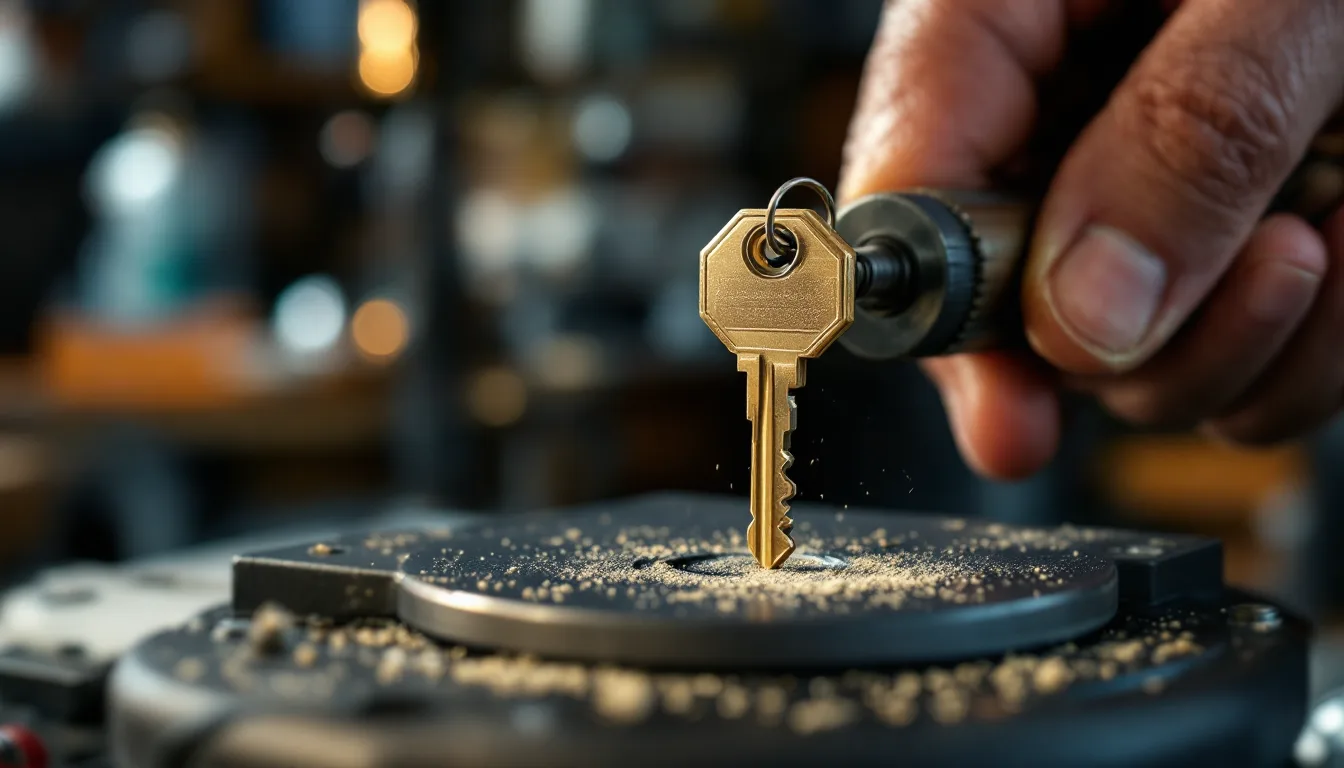
What does key duplication involve, and why does the quality of the copy matter?
Key duplication sounds like the simplest job a locksmith does, and in some ways it is. But a copy is only as good as the cut, and a poor cut is the reason so many people end up standing at their own front door with a spare that sticks, grinds, or turns only if you jiggle it just right. A key works by lifting a set of pins or wafers to exact heights. A few thousandths of an inch off at one position and the lock may still open, but it will wear faster, and sooner or later it will stop opening at all.
We have been cutting keys since 1987, and the most common thing we see is a copy of a copy. Someone cuts a key at a hardware counter, that copy gets copied, and by the third or fourth generation the cuts have drifted far enough that the key fights the lock. If you have a spare house key that never quite worked right, that is almost always the cause. The fix is to cut a fresh key from the original, or from a key that we have checked against the lock first.
This page covers what we copy, how we do it, what changes the cost, and how it plays out specifically in Westmont, where a lot of homes are older, a lot of households rent, and a lot of keys get handed from person to person. If you would rather just talk it through, call (213) 577-1366 and David or one of our technicians will answer, day or night.
Which keys can we copy, and which ones need a different approach?
Most keys people ask us about fall into a short list, and nearly all of them are straightforward. Some are not, and it is better to know that before you plan around having a copy by the end of the day.
Keys we cut routinely include standard house and apartment keys, deadbolt keys, padlock keys, office and storefront keys, file cabinet and desk keys, and mailbox keys. Duplicate deadbolt keys are especially common here, because many older homes have a deadbolt added later that uses a different key from the knob lock.
Restricted and high-security keys are the exception. These are keys stamped with a do-not-duplicate marking, or keys tied to a patented keyway where blanks are controlled. Whether we can copy one depends on the specific system, and on whether you can show that you are authorized to have copies made. Sometimes the answer is yes with proof of authorization, sometimes the manufacturer or the property manager has to approve it, and occasionally the honest answer is that the key can only be ordered through the original source. We will tell you which case you are in rather than cutting something that will not work or should not be copied. If you are weighing a restricted system for your own door, our page on high-security locks explains how those systems control key copying.
- House, apartment and deadbolt keys: usually cut on the spot
- Office and commercial keys: usually straightforward, unless the system is restricted or part of a larger master arrangement
- Mailbox keys: small and often overlooked, but easy to copy when the blank is available
- Restricted or high-security keys: confirmed case by case, sometimes needing authorization
- Keys worn smooth or bent: we can often still use them, but may recommend cutting from the lock instead
Locked out or need a locksmith now?
We answer around the clock, every day of the year.
Call (213) 577-1366How do we duplicate a key, step by step?
There is no mystery to how we work. Here is the order we follow, whether you walk into the storefront or we come to you in a van.
- Identify the key. We look at the keyway, the brand stamping and any markings, and confirm what kind of lock it belongs to. If it says do not duplicate, we stop here and talk about options.
- Match the blank. Blanks are not interchangeable even when they look alike. We choose the one that fits the keyway and the lock's brand profile, because a near match will cut but not run smoothly.
- Check the original. If the key is worn, bent, or itself a copy of a copy, we say so. A worn original makes a worn duplicate, and sometimes the better move is to cut from the lock's code or by decoding it.
- Cut and deburr. We cut the duplicate to the original's profile, then remove the burrs left by cutting. Burrs are what chew up a lock over time, so this step is not optional.
- Test in the actual lock. We run the new key in the lock it is meant for, several times, and check that it turns freely both ways. A key that only works on the bench is not finished.
- Hand it over with advice. If the original is so worn that copies will keep degrading, we tell you, and we suggest whether replacing or rekeying is the sounder fix.
How much does key duplication cost in Westmont?
We do not quote numbers on a web page, because the honest answer depends on the key in your hand. What we can do is tell you exactly what moves the cost up or down, so nothing surprises you when you call (213) 577-1366.
A plain, common house key is usually the more economical end of the work. Specialty blanks, high-security profiles, restricted keyways, and keys that need to be cut by code rather than copied from an original all take more time and more costly materials. Quantity matters too, since a landlord cutting keys for several units is doing different work than someone who needs one spare.
Where the work happens also changes things. Bringing the key to our Westwood storefront is usually the lighter-cost option. A mobile visit covers the van, the technician's travel, and the time at your door, so it makes sense when you cannot get to us, when you need the keys cut with the lock in front of us, or when you are dealing with several locks at one property. Westmont sits roughly 14 miles from our base, and travel is part of the picture for a mobile call.
Time of day is the last factor. Keys cut during normal hours at the shop are one thing; a late-night mobile visit is another. We will explain which of these apply to you before any work begins, and we will not start cutting until you understand the job.
- Key type: common residential blanks versus specialty, high-security or restricted blanks
- Condition of the original: a clean key versus one that has to be decoded or cut from the lock
- How many keys you need
- Shop visit versus mobile service
- Time of day and how quickly you need the work done
Locked out or need a locksmith now?
We answer around the clock, every day of the year.
Call (213) 577-1366What should renters, landlords and small building owners in Westmont know about spare keys?
Westmont has a large share of renters, and that shapes how key duplication works here more than any other single fact. Small multifamily buildings and two-story apartment buildings sit alongside older single-family homes, and in many of them keys have passed through several tenants, a manager, a relative, and maybe a contractor. Nobody is quite sure how many copies exist.
If you are a tenant, the practical points are simple. Check your lease before duplicating a key, since some buildings require the manager's permission, and some keys are stamped against copying. If you have lost the only key you had, that is a different problem from needing a spare, and our guide to apartment lockouts covers getting back in.
If you are a landlord or manage a few units, here is what we tell people. A pile of spare keys at turnover is not the same as control of the building. When a tenant leaves, you cannot know who kept a copy, and the clean answer is usually to rekey the locks so that old keys stop working, and then cut a fresh set. Duplication alone does not remove old copies from circulation. For owners handling several properties or frequent turnover, we have a page for locksmith services for landlords that covers how we work with ongoing rentals.
Keep a short written record of how many keys exist for each unit and who holds them. It costs nothing, and it saves arguments at move-out.
What does key duplication look like around Westmont's streets and ZIP codes?
Westmont is a densely built unincorporated area in Los Angeles County, covered by ZIP codes 90044 and 90047. The housing is a real mix: 1920s to 1940s bungalows and Spanish-style cottages, small postwar homes, and two-story apartment buildings, especially along Vermont, Normandie and Western avenues. That mix produces very different key needs depending on which block you are on.
Along the Vermont Avenue and Western Avenue corridors, the common scenario is apartment living: lockouts, shared entry keys, and mailbox lock changes. A building with a cluster of mailboxes and a front gate or security door can easily have three or four different key types in play, and tenants often need an extra copy of each. Mailbox keys are small and easy to overlook, but when a mailbox lock has been changed or replaced, the new keys need to be cut cleanly. If the lock itself is failing rather than the key, mailbox lock replacement is the better fix than another copy.
Around the Jesse Owens Park area and the older streets near Vermont Knolls and Morningside Park, you find the bungalows. Many have security screen doors and window bars, which means at least two locks per entrance and often a different key for each. People tend to lose track of which key goes with which lock, and a spare house key for the screen door and another for the deadbolt is a very common request. Older bungalows also tend to have deadbolt and security-door hardware that was upgraded piecemeal over the decades, so duplicate deadbolt keys are rarely the same as the knob lock keys.
On the Century Boulevard and Manchester Avenue corridors, the work shifts toward storefront keys, back-door keys and office keys. A business may need several copies for staff and want a record of who has which, which is a point where a master key system starts to make sense.
One small local note: the climate here is mild, with regular morning marine layer, and corrosion is minor. Damp winter mornings can swell older wood doors and frames, though, and a door that binds is sometimes blamed on a bad key. Before assuming a new copy is faulty, check whether the door itself is sticking.
Locked out or need a locksmith now?
We answer around the clock, every day of the year.
Call (213) 577-1366When does mobile key duplication make sense?
Plenty of people assume key cutting means a trip to a counter. For a lot of Westmont customers that is the more economical route, and our storefront at 10740 Wilshire Blvd in Westwood is open to anyone who wants to bring keys in. But there are real situations where we are better off coming to you.
Mobile key duplication makes sense when you have no spare to bring in, because we can work from the lock. It makes sense when you need keys for several doors at one property, like a small multifamily building, since the technician can test each key in its own lock on the spot. It also makes sense for elderly customers, people without a car, or business owners who cannot leave a counter unattended. And it is the right call for a restricted or unusual keyway, where we want to see the lock before cutting anything.
Our vans are stocked with a key machine and a range of common blanks, but not every blank for every lock, so when you call we will ask what the key looks like and what brand the lock is. That lets us tell you whether we can finish the job in one visit. You can read more about how our vans work on our mobile locksmith page.
We answer the phone at (213) 577-1366 around the clock, every day of the year, so you can reach us whether you are planning ahead or something has gone wrong at night.
Why call Wilshire Lock & Key for spare keys?
Honest differentiators matter more than slogans, so here is the short list. We have been in business since 1987. We have a real storefront in Westwood plus mobile vans, and we serve 140 cities across Los Angeles and Ventura counties. When you call, you reach our company, not a call center that passes your request to whoever is available. There is no dispatch middleman between you and the person cutting your key.
David, the owner and lead technician, oversees the work. That means the standards on how a key is cut, deburred and tested come from one person who has been doing this for a long time, not from a rotating set of strangers.
One more thing worth saying plainly: California requires locksmith companies to hold a locksmith company license from the Bureau of Security and Investigative Services (BSIS), called an LCO license. You should ask any locksmith, including us, for that license number before work begins. It is a reasonable question and a good habit, especially if the person is going to be working on your front door or cutting keys to your property.
Locked out or need a locksmith now?
We answer around the clock, every day of the year.
Call (213) 577-1366What about car keys and keys that are more than a simple cut?
We get asked about car keys on key duplication calls, and the honest answer is that it depends heavily on the vehicle. Many modern car keys contain a chip that has to be programmed to the vehicle, so a simple cut is not enough. Whether a given key needs programming, and whether it can be done by a locksmith or only by a dealer, varies by make, model and year. We do not guess. We confirm by VIN, and sometimes in person, before telling you what is possible. If a particular key turns out to be dealer-only, we will say so rather than let you wait on us.
If your vehicle key has a chip, our transponder key programming page explains how that process works, and our car key replacement team can help if you have no working key at all.
The same principle applies to any key that is not a plain mechanical cut: restricted keys, patented keyways, and keys tied to a larger system. Call first, describe what you have, and we will tell you plainly what can be done.
Frequently asked questions
Can you copy a key marked 'Do Not Duplicate'?
That marking is a request, not a legal barrier in every case, but we take it seriously. Whether we can copy the key depends on the system it belongs to and whether you can show you are authorized, such as being the owner or having permission from the property manager. Some restricted keys can only be ordered through the original source. Call (213) 577-1366 and describe the key, and we will tell you which case applies.
Do I need to bring the original key, or can you cut one from the lock?
A working original is the easiest starting point. If you have no key at all, we can often cut one from the lock itself, either on site with a mobile visit or by decoding the lock. That is more involved than copying a key, so it takes more time, but it is a routine part of our work.
Why does my copied key stick or not turn smoothly?
Usually the copy was cut from another copy, so the cuts have drifted, or the blank was a near match rather than the correct one. Burrs left from cutting can also cause grinding. We can cut a fresh key from your original, test it in the lock, and tell you if the lock itself is worn.
Can you copy mailbox keys in Westmont?
Yes, in most cases. Mailbox keys are small and the blanks are common, so we can usually cut them quickly. If the mailbox lock itself is damaged or has been replaced, the better fix may be a new lock with new keys rather than another copy of the old one.
Can I get duplicate deadbolt keys if I only have the knob key?
Often the deadbolt and knob use different keys, especially in older bungalows where one was added later. We would need the actual deadbolt key, or access to the lock to cut one. If your deadbolt and knob are keyed alike, one key already works for both, and we can copy that.
Do you come to my home or business to cut keys?
Yes. Our mobile vans carry key machines and a range of common blanks, and we serve Westmont and the surrounding area. When you call, tell us the lock brand and what the key looks like so we can say whether we can finish the job in one visit. You can also bring keys to our storefront at 10740 Wilshire Blvd in Westwood.
Is duplicating a key enough when a tenant moves out?
Not by itself. Duplication makes more copies but does nothing about the copies that already exist. When a tenant leaves, rekeying the lock is the way to make old keys stop working, and then new keys can be cut. We can explain the options for a single unit or a small building.
Can you duplicate an office or commercial key, including keys in a master system?
Plain office and storefront keys are usually simple. Keys that belong to a master key system or a restricted keyway need more care, because copying them can affect security for the whole building. We will ask who is authorized and may need approval from the system's owner before cutting.
Can you copy a car key?
It depends on the vehicle. Some car keys are purely mechanical and can be cut like a house key, while many contain a chip that must be programmed. Because the details vary by make, model and year, we confirm by VIN or in person before saying what is possible, and we will tell you honestly if a key is dealer-only.
What hours can I call about key duplication?
Our phone line, (213) 577-1366, is answered 24 hours a day, seven days a week, year-round. Planned spare-key work is easiest during normal shop hours, but you can call at any hour to ask questions or arrange a mobile visit.
More locksmith help in Westmont
Key Duplication near Westmont
Reviewed by David, Owner & Lead Technician, Wilshire Lock & Key — in the locksmith trade since 1987.
Last updated 2026-10-11.