
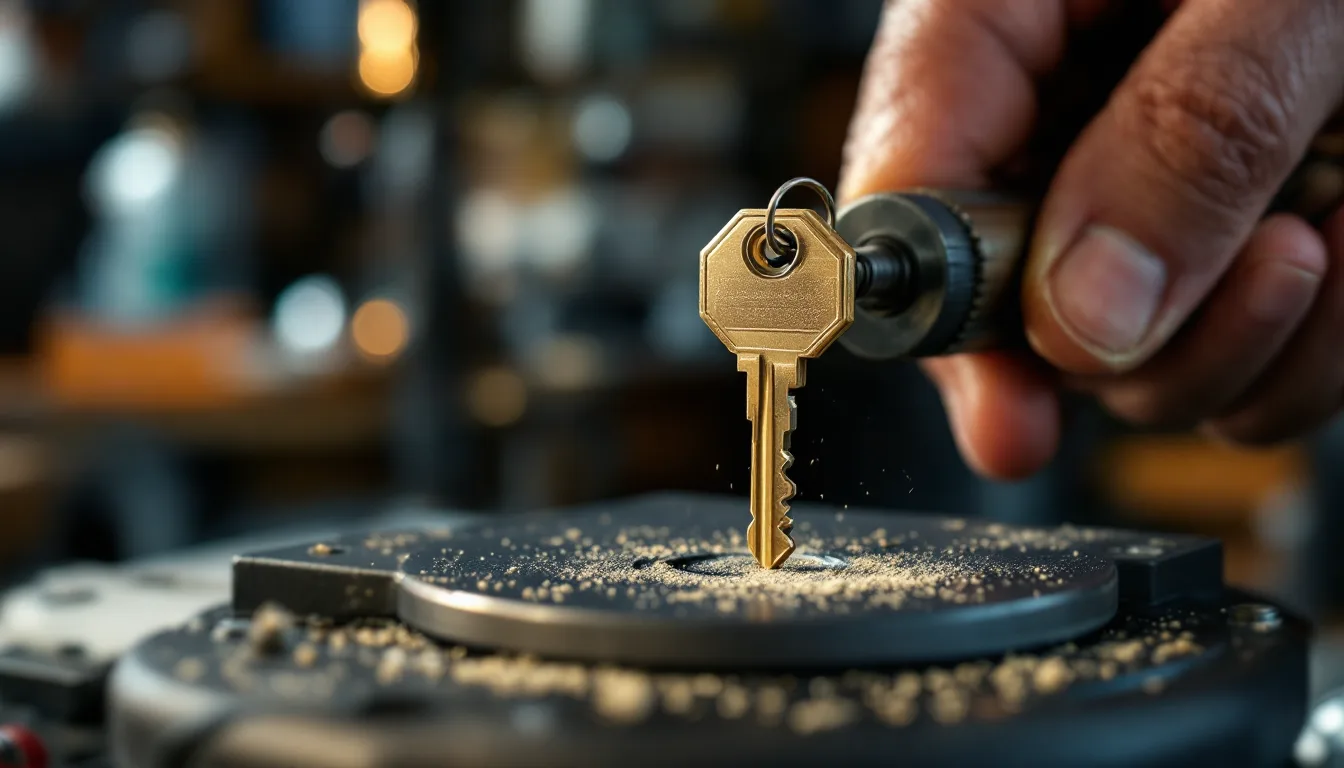
What does key duplication actually involve?
Key duplication sounds like the simplest job in our trade, and it often is. But a key copy is only as good as the cut, the blank it is made on, and the key it was traced from. A copy that almost fits is worse than no copy at all, because it works on a good day and jams on a bad one, usually when you are standing outside with groceries or a customer is waiting at your door.
At Wilshire Lock & Key, key duplication means matching the cuts of your original onto the correct blank, then checking the result in the lock it is meant to operate. We have been doing this since 1987, and the habit that has stuck the longest is simple: we do not hand over a key we have not tried.
This page covers house key copies, spare house keys, apartment key copies, duplicate deadbolt keys, office and commercial key duplication, mailbox key duplication, and the harder categories: high security and restricted keys. It also covers what we can do for you in Fillmore without you driving to our Westwood storefront.
When do people in Fillmore need duplicate keys?
Most calls about key copying are not emergencies. They are ordinary moments in a household or a business where one key is no longer enough. Some of them are worth planning for before they turn into a lockout.
Here are the situations we hear about most often:
- A new household member, a roommate, or a grown child who needs their own house key copy.
- A spare house key you want to leave with a trusted neighbor or relative instead of hiding it under a pot.
- Your only key is worn down so far that it sticks, spins, or has to be wiggled before the lock turns. A copy from a worn key inherits the wear, so this is the moment to copy it or have the lock looked at.
- An office manager who needs enough keys for a growing team and wants them to cut cleanly rather than loosely.
- A mailbox key that has gone missing, or a household that shares one key between several people.
- A property owner handing over a unit and wanting working copies for each tenant.
- Someone who just received keys to a new place and wants a spare made before the first one is lost.
How do we copy a key, step by step?
The process is not complicated, but the order matters. Skipping the checks is where most bad copies come from.
- Identify the key. We look at the brand, the keyway, and any stamps on the bow to decide whether this is a standard key, a high security key, or a restricted one. That decides everything that follows.
- Choose the right blank. A blank has to match the profile of the original, not just look close. A wrong blank can cut cleanly and still not turn the lock.
- Inspect the original. If the cuts are badly worn, we say so. Copying a worn key faithfully copies its problems, and sometimes the better route is to cut by the lock's code or to look at the lock itself.
- Cut the copy. The cuts are traced and then cleaned so no burrs are left on the blade. Burrs scratch the inside of the lock and wear it faster.
- Test it in the lock. We run the new key in the actual lock where we can. For deadbolts, we check that the bolt throws fully and retracts without force.
- Compare the two keys. If the copy turns more roughly than the original, we recut or start over rather than send it out the door.
Locked out or need a locksmith now?
We answer around the clock, every day of the year.
Call (213) 577-1366Which keys can be copied, and which cannot?
Not every key is a ten-second job, and being honest about that is part of the service. Here is how the main categories break down.
Standard house and deadbolt keys are the most straightforward. A duplicate deadbolt key is cut the same way as any other standard key, though deadbolts take more care in testing because they are used with a throw bolt that exposes any misalignment immediately. Apartment key copies work the same way, with one practical note: if your lease says keys may not be duplicated, check with your landlord first. We will copy what you are entitled to copy.
Mailbox key duplication is a small job with a few quirks. Mailbox keys are often small and flat, and some cluster boxes use keys controlled by the postal service rather than by the building. If your mailbox is a private one, we can usually copy the key. If it is a postal-controlled lock, the key typically has to come through the post office, and we will tell you so instead of trying to work around it. When a private mailbox lock has lost its key altogether, mailbox lock replacement is the practical alternative.
Office and commercial key duplication follows the same basic process, but the keys often belong to a larger system. If a key is part of a hierarchy, with some keys opening only certain doors and others opening many, we want to know that before cutting. Who is allowed to hold which key is a decision for the owner or manager, and we can set up or reorganize that with a master key system when a business has outgrown a pile of loose keys.
High security key duplication and restricted key duplication need more care. Some keyways are protected, which means the blanks are controlled and copies can only be made with proper authorization, often through the original dealer or a registered card. A stamp reading "Do Not Duplicate" is a request, not a lock, and it does not stop a hardware store machine. But on a genuinely restricted system we ask for authorization, and we will tell you if the right route is to order keys through the manufacturer. If you are weighing whether to move to a controlled system, our page on high security locks explains the difference.
Car keys are a separate category. A plain metal car key can be cut like any other. A key with a transponder chip has to be programmed to the vehicle in addition to being cut, and whether it can be done depends on the make, model, and year. We confirm that by VIN or in person rather than guess, and some vehicles are dealer-only. For those, transponder key programming is the page to read next.
Locked out or need a locksmith now?
We answer around the clock, every day of the year.
Call (213) 577-1366How much does key duplication cost in Fillmore?
We do not quote numbers on a web page, because the honest answer depends on the key in your hand. Here is what moves the cost, so you know what you are paying for.
The first factor is key type. A plain brass house key is a different job from a high security key with a milled profile, and both are different from a restricted key that needs authorization before anything can be cut.
The second is the blank. Common blanks are easy to stock. Less common or brand-specific blanks may need to be sourced, and that affects both the cost and how long it takes.
The third is how many copies you need. Cutting several keys at the same sitting is usually the more economical route than coming back repeatedly, because the setup is done once.
The fourth is where the work happens. A key cut at our storefront at 10740 Wilshire Blvd is a different kind of job from a mobile visit to your door in Fillmore, which includes the travel. If you can combine duplication with other work on the same visit, such as a rekey, that usually makes the trip more worthwhile.
The fifth is the condition of the original. If the key is so worn that a clean copy is not possible, the honest fix may be cutting from the lock's code or addressing the lock itself, and that changes the scope. Call (213) 577-1366 and describe the key; we will tell you what category it falls into and what drives the cost before anything is done.
What does key duplication look like around Fillmore?
Fillmore is a single-family town with a few distinct personalities, and each one shapes how keys get used and copied.
Around Downtown Fillmore and the Central Avenue district, many homes are early-1900s bungalows and 1920s to 1940s cottages. These often carry older hardware, and old keys can be worn, bent, or built on blanks that are harder to match than a modern key. If you have a vintage key near downtown and you want a spare, bring the original sooner rather than later. A key that has worked for decades is exactly the one that can snap on the day you most need it. Where an old lock is itself the problem, lock repair is the sibling service to consider.
Summer heat matters here. Fillmore sits inland in the Santa Clara River Valley with hot, dry summers, and heat can swell wood doors and frames in older houses. A swollen door makes a lock bind, and people often blame the key for it. Before you pay for a replacement copy, check whether the key turns easily when the door is open. If it does, the key is probably fine and the door alignment is the issue. Valley dust is the other factor: it works into exterior lock mechanisms over time and wears keys faster.
Heritage Grove, on the north side, has added newer tract homes in recent years. Buyers there often want to know how many keys exist for the house, because tract homes have usually passed through builders, agents, and contractors before the new owner. The usual sequence is to rekey the locks so old keys stop working, then cut as many fresh copies as your household needs. Rekeying first means the copies you make are for keys only your household holds.
Out past the edge of town, around Bardsdale and the valley floor, citrus ranch properties come with gates and outbuildings. Those properties tend to need a lot of keys: one for the house, others for sheds, equipment buildings, and gate padlocks. Duplication helps there, and if a gate lock is sticking from dust or wear, gate lock repair is worth a look before you copy keys to a lock that is on its way out.
For ZIP code 93015, which covers Fillmore, we serve households and businesses in North Fillmore as well as the central district. Piru, nearby and unincorporated, is also within the area we reach.
Locked out or need a locksmith now?
We answer around the clock, every day of the year.
Call (213) 577-1366Can we come to you for key duplication in Fillmore?
Yes, in many cases. Our base is the storefront in Westwood plus mobile service vans, and Fillmore is about 55 miles from that base, so we do travel for the work. Whether a given key can be cut on the spot at your door depends on the key type and the blank. Standard keys are the most likely candidates. High security keys, restricted keys, and unusual blanks may need to be brought back to the shop.
For a quick job, the simplest approach is to call (213) 577-1366, describe the key, and ask. The line is answered 24 hours a day, 7 days a week, all year, so you can ask at an odd hour if that is when it occurs to you. We will tell you honestly whether a mobile visit makes sense or whether another arrangement fits better. Our mobile locksmith page explains how those visits work in general.
Why call Wilshire Lock & Key for spare keys?
A key copy is a small job, so why does the choice of company matter? Because small jobs reveal how a business works. Here is what we can say plainly about ours:
- We have been in business since 1987. Key duplication was part of the trade then and it is now, and we have seen most key types you are likely to pull out of a drawer.
- We have a real storefront at 10740 Wilshire Blvd in Westwood, plus mobile vans, so there is an actual place behind the phone number.
- We are one company, not a dispatch service passing your call to whoever is available. The person who answers is part of the team that does the work.
- David, the owner and lead technician, oversees the work. If something is unusual, the decision is not left to guesswork.
- We serve 140 cities across Los Angeles and Ventura counties, which includes Fillmore.
Should you ask your locksmith about licensing?
Yes, and you should ask any locksmith, not just us. California requires locksmith companies to hold a BSIS LCO license. It is a reasonable question to ask before anyone cuts keys for your home or business, and a legitimate company will answer it without fuss.
It is also worth asking what the copy is being cut from, whether the key will be tested, and what happens if it does not work. The answers tell you more about the business than any slogan does.
Frequently asked questions
How long does it take to copy a house key?
For a standard house key it is usually a short job once we have the right blank on hand. We do not put a clock on it, because a worn original, an unusual blank, or a restricted keyway can change things. If you call (213) 577-1366 and describe the key, we can say whether it falls in the straightforward category.
Can you make a duplicate deadbolt key?
Yes. Standard deadbolt keys are cut the same way as other keys, but we test them in the deadbolt itself because the bolt shows a poor cut immediately. If the deadbolt has a high security or restricted keyway, we will tell you what that requires.
What if my only key is worn out?
A copy of a worn key copies the wear. If the key is still usable, we can often make a clean copy and test it. If it is too worn, the better route may be cutting by the lock's code or looking at the lock, since it may be the lock that is worn. Do not wait until it breaks in the lock; that turns a copy into a broken key extraction job.
Can you copy a key marked "Do Not Duplicate"?
That stamp is a request, not a technical block. A stamped key on an ordinary keyway can often physically be copied, but you should have the right to do so. On genuinely restricted systems, we ask for authorization and may direct you to the dealer or manufacturer for authorized copies.
Do you copy mailbox keys?
For private mailboxes, usually yes. Postal-controlled cluster box locks are different and typically have to be handled through the post office. If your private mailbox key is gone completely, replacing the lock may make more sense than hunting for a match.
Can you duplicate keys for an office or business?
Yes. We copy office and commercial keys, and we ask whether the key belongs to a larger system first. For businesses that need to control who holds which key, a master key system is often the cleaner long-term answer than copying keys one at a time.
Can you copy a car key?
A plain metal car key can be cut like any other key. A key with a transponder chip must also be programmed to the vehicle, and the details depend on the make, model, and year. We confirm by VIN or in person, and some vehicles are dealer-only, which we will tell you directly.
Should I rekey my locks before making spare keys?
If you are not sure who holds keys to the house, yes. That is common with a newly bought home, including newer tract homes. Rekeying first makes sure old keys no longer work, and then every copy you cut is for a key only your household holds.
More locksmith help in Fillmore
Key Duplication near Fillmore
Reviewed by David, Owner & Lead Technician, Wilshire Lock & Key — in the locksmith trade since 1987.
Last updated 2026-10-11.