
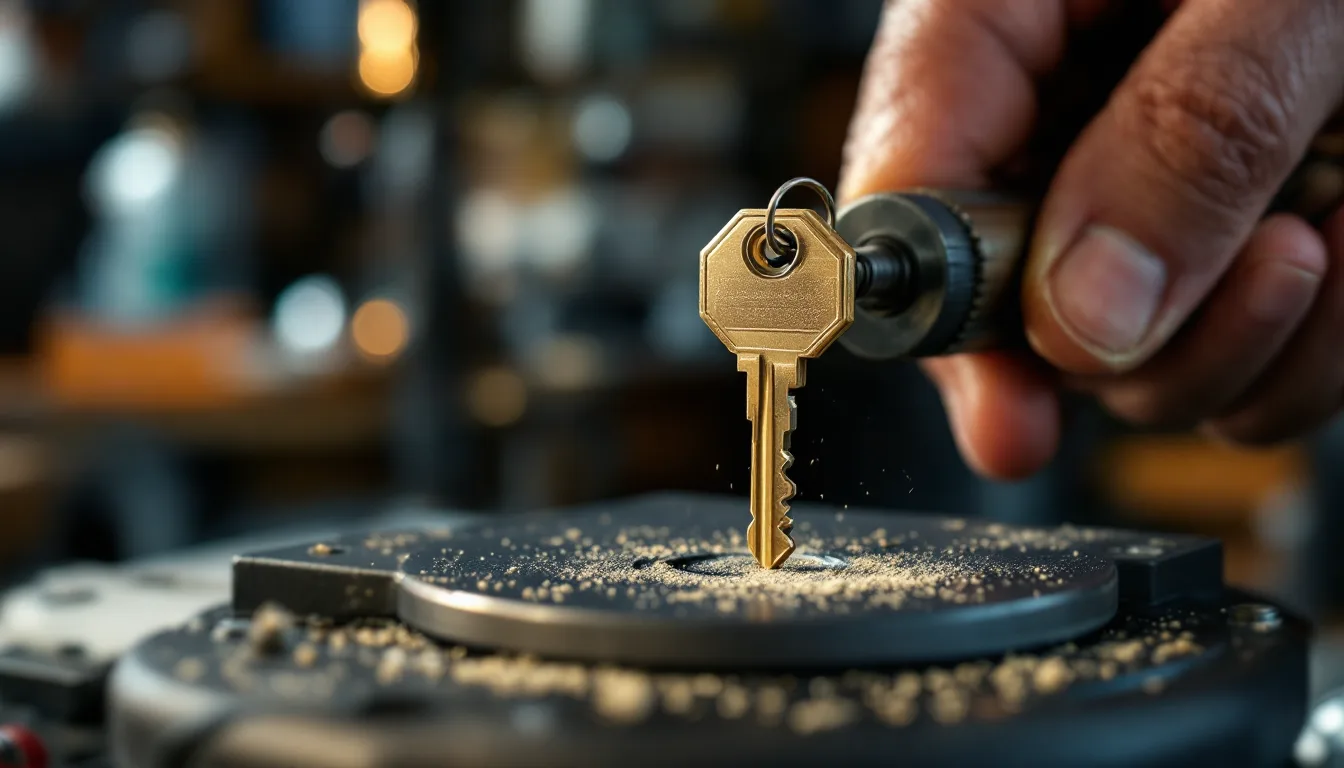
Why do some key copies stick, jam, or not turn at all?
Most bad copies come from one of three places: a worn original, the wrong blank, or a rushed cut. Copying a key is a measuring job. The cutting machine follows the profile of the original, so every flaw in that original gets carried onto the new key. That includes rounded shoulders, flattened peaks, and a slight bend. Copy the copy and the error stacks. After a couple of generations you have a key that only works if you jiggle it, and a lock that wears out faster because of the jiggling.
Downey has a lot of homes old enough that the keys in the kitchen drawer are old too. A 1940s bungalow or a 1960s ranch-tract house often has a deadbolt added decades after the house was built, a knob set from another era, and a ring of keys nobody can match to anything. Before we cut a single key, we want to know which key belongs to which lock, and whether the original is in good enough shape to copy from.
The fix is not complicated. It takes a clean original, the correct blank for that keyway, and a finished cut that is tested before you leave. The rest of this page explains how we do that, what changes the cost, and where key duplication stops and a different service, like rekeying, makes more sense.
How do we duplicate a key, step by step?
Whether you walk into our Westwood storefront or one of our vans meets you in Downey, the process is the same. We do not treat a house key like a commodity item, because the small steps are what separate a copy that works on the first try from one that sticks in the lock.
- Identify the key. We look at the keyway, the brand stamping, the shape of the bow, and whether it is a standard key, a high-security key, or a restricted one. That tells us what blank and what process apply.
- Judge the original. We check for wear, bends, and cracks. If the original is badly worn, we tell you, because a copy of a tired key is a tired key. Sometimes the better move is to cut from a cleaner key or work from the lock itself.
- Match the blank. The blank has to fit the keyway, with the right length and shoulder position. Blanks that look nearly identical are often not interchangeable.
- Cut and finish. We cut on a calibrated machine, then remove the burrs left on the edges. Leftover burrs are a common reason a new key drags in the lock and leaves brass shavings in the cylinder.
- Test the copy. Where we have the lock in front of us, we test the new key in it, turning it fully and retracting the bolt several times. We test the original beside it so you can feel the difference, if any.
- Hand it back with advice. You get your original and your copies. If a lock is stiff, a latch is misaligned, or a key is close to failing, we say so now rather than after it breaks.
Locked out or need a locksmith now?
We answer around the clock, every day of the year.
Call (213) 577-1366What affects the cost of duplicate keys?
We do not publish numbers on a web page, because a key copy is not one fixed job. A plain brass house key and a high-security key share the word duplication and very little else. Here is what moves the cost up or down:
- Key type. Standard keys for common locks are the more economical route. High-security and restricted keys use specialized blanks and sometimes special machines.
- Blank availability. Some blanks are easy to find and some are controlled by the manufacturer or ordered in specially.
- Quantity. Cutting several keys in one sitting is usually more efficient than coming back for each one later.
- Where the work happens. Visiting our storefront and having a van come to your door are different services, and mobile service is priced with travel in mind.
- Condition of the original. A worn or damaged original can mean extra work, such as cutting by code or working from the lock.
- Authorization requirements. Restricted keys can require paperwork or a card, which adds steps.
- Commercial systems. Keys that belong to a master key hierarchy need the system records checked first.
- Time of day. Our phone is answered around the clock, and after-hours visits are handled differently from a daytime stop at the shop.
House, apartment, and deadbolt keys: what to copy and what to think about first
A house key copy is the most common request we get, and the most common mistake is making only one spare. Think about who actually needs a key: each adult in the household, a trusted neighbor or relative, perhaps a dog walker. Make a spare house key for each real need, then keep one set somewhere that is not under the doormat or inside a fake rock.
Many Downey homes have two or more different keys on the front door alone, usually one for the knob or handle set and a separate one for the deadbolt. If you want a duplicate deadbolt key, bring the one that actually turns that bolt, and tell us if the lock has been changed since the house was built. Different locks on one house may be keyed alike or not, and it is worth knowing which before you start cutting.
Apartment key copy requests come with a rule of their own: your lease often says whether you may duplicate keys, and some buildings use restricted keys that only the property manager can authorize. If your lease allows copies, we can usually handle a standard apartment key quickly. If the key is stamped or restricted, we will tell you what the building has to approve. Landlords and property managers who want help organizing keys across several units can look at our locksmith services for landlords.
One more point: copying a key only helps when you know who holds the existing ones. If you have just bought a home, ended a tenancy, or had a key go missing, extra copies are not the answer. In those cases a lock rekey changes the pins inside the lock so that old keys stop working, and then we cut fresh keys for the new setup.
Locked out or need a locksmith now?
We answer around the clock, every day of the year.
Call (213) 577-1366Can you do office and commercial key duplication?
Yes, with a few more questions up front. Commercial key duplication usually involves keys that belong to a system: a few employees may have access to the front door, others to the back office, a manager to everything. If a key is part of a master key hierarchy, the person who owns the system decides who gets copies. We will ask who is authorizing the request, and we may need to confirm it against the records for that building.
For offices that have grown over the years and now have keys that nobody can account for, a master key system can bring order. That is a separate project from copying a single key, though, so we treat it as one. For everyday office key copying, bring the original, tell us which door it belongs to, and we will cut it, test it, and tell you if the lock needs attention.
A practical tip for business owners: keep a simple log of who has which key, and cut copies in small batches as people join, rather than handing out a copy of a copy. It keeps the cuts accurate and makes it far easier to see when something has gone missing.
What about mailbox key duplication?
Mailbox key duplication is one of the smaller jobs we do, and one of the ones with the most confusion around it. A private mailbox on a house, a post-mounted box, or an office mail slot with its own lock can generally be copied the same way as any small-format key. We match the blank, cut it, and test it.
Locks on shared cluster boxes at apartment complexes are different. Those are often controlled by the Postal Service or by the property, and the keys are restricted for good reason: they protect everyone's mail. If you have lost a key to one of those, your property manager or the local post office is the right first call. When a lock itself is worn out or damaged and the property owns it, our mailbox lock replacement service covers the lock rather than the key.
Can high-security and restricted keys be copied?
Sometimes yes, sometimes only through the manufacturer, and we will tell you which at the counter or on the phone. High-security keys, which often have unusual shapes, internal cuts, or extra security features, are built to resist casual copying. Many can be duplicated by a locksmith with the right equipment and authorization, and some cannot be duplicated locally at all.
Restricted keyways work through control. The manufacturer holds the blanks, and a copy normally needs a signature, a card, or proof that you are the authorized owner. We do not skip that step, and you would not want a locksmith who did. A stamp reading do not duplicate is not a physical barrier, but we treat it as a flag and ask about authorization before cutting.
If you are not sure what kind of key you have, bring it in or describe the stamping over the phone. If it turns out the lock itself is the problem, for example a system with a lost authorization card, we can also talk through upgrading to high-security locks where you control who gets copies. Vehicle keys with chips are a different category: a cut alone often will not start the car. We confirm what applies by VIN and in person, and for those we point you to our transponder key programming rather than treating them as ordinary door keys.
Locked out or need a locksmith now?
We answer around the clock, every day of the year.
Call (213) 577-1366Mobile key duplication: when we come to you
Plenty of people do not have time to drive across town for one extra key. Our mobile locksmith vans carry portable cutting equipment and a range of common blanks, so many standard house, office, and mailbox keys can be cut at your door. Our storefront at 10740 Wilshire Blvd in Westwood is about 21 miles from Downey, and the vans exist so that distance does not become your problem.
Mobile service has limits, and we say so plainly. Some blanks are not carried in the van, and some high-security or restricted keys need shop machinery or manufacturer authorization. When that is the case, we will tell you on the call, so you are not waiting around for a van that cannot finish the job. Calling (213) 577-1366 gets you a person at any hour, and describing the key helps us decide which route works best.
Key duplication around Downey: what the neighborhoods tend to need
Downey covers ZIP codes 90240, 90241, and 90242, and the key requests that come from them vary with the housing. In Northeast Downey, known for larger custom homes and ongoing teardown-rebuild activity, we see people who have just bought or finished a rebuild and want a full set of fresh keys. Whole-house rekeys for buyers in Northeast Downey and Orange Estates are common, and copies follow naturally once the locks are keyed the way the new owner wants. Orange Estates still has older estate-style homes on generous lots, and those often have multiple entry doors, side gates, and outbuildings, each with its own key that has to be matched.
Across Southwest Downey, Southeast Downey, Northwest Downey, and the neighborhoods around Furman Park and Rio San Gabriel Park, the single-family streets of 1940s bungalows and 1960s ranch tracts make up much of the city. Those homes often have old original keys, and the best time to make a good copy is before the original wears out completely, not after it breaks off in the lock.
Apartment corridors run along Paramount Boulevard and other major streets. Residents there regularly ask for an apartment key copy for a roommate or family member, and the first question is always whether the lease permits it. If a tenant is locked out instead, that is a different call, covered under our apartment lockout service.
On the business side, storefront work along Firestone Boulevard and at Stonewood Center often starts with keys: extra copies for new employees, replacement keys for a closing manager, or duplicates for a vendor who needs after-hours access. In the hospital corridor near Brookshire Avenue, medical offices tend to need tight control over who holds which key, so we pay attention to authorization and records on those requests.
Climate plays a small part here. Downey sits on the inland coastal plain, so salt-air corrosion is not a practical concern, and keys here do not usually suffer from it. Summer heat is another story. It can swell wood doors slightly, especially older unshaded south-facing entries, and a swollen door puts pressure on the bolt that wears the key and the lock faster. If a key suddenly drags in summer and eases in cooler weather, the door may be the cause, and a new copy will not fix it.
Locked out or need a locksmith now?
We answer around the clock, every day of the year.
Call (213) 577-1366Why call Wilshire Lock & Key for key cutting?
We have been in business since 1987, serve 140 cities across Los Angeles and Ventura counties, and Downey is one of them. We run a real storefront in Westwood plus mobile service vans, so you can walk in or have us come to you. When you call, you reach us. There are no dispatch middlemen passing your job to a company you have never heard of, and David, the owner and lead technician, oversees the work.
California requires locksmith companies to hold a BSIS LCO license, and you should ask any locksmith you call to show you theirs before they touch your locks. It is a reasonable question for any trade, and it is one that sorts out who is serious.
Our phone is answered 24 hours a day, seven days a week, year-round at (213) 577-1366. Key cutting is rarely a midnight emergency, but sometimes it is: a spare is needed before a house sitter arrives, a new employee starts at dawn, or an original has just snapped. If you need us, call.
Frequently asked questions
How long does it take to copy a house key?
A standard house key on a common blank takes only a short time at our storefront, usually while you wait. Special blanks, high-security keys, or restricted keys can take longer because they need different equipment or authorization. Call (213) 577-1366 and describe the key, and we will tell you which kind of job it is.
Can you copy a key marked do not duplicate?
Sometimes. The stamp is not a physical barrier, but we treat it as a signal and ask about authorization before cutting. Restricted keyways usually need a signature, a card, or the system owner's approval. If we cannot copy it, we will explain the options, which may include going through the manufacturer.
Can you make a key if I only have one original and it is worn?
We can try. A heavily worn original can produce a copy that sticks or fails to turn. In that case we may cut from a cleaner key, work from the lock itself, or suggest a new key set. We will tell you what we see before we cut anything.
Should I copy my keys or rekey the locks?
If you know exactly who has keys and you simply need more, copying is the lighter-cost option. If you have moved into a new home, a tenant has left, or a key has gone missing, rekeying makes more sense because it stops old keys from working. Many customers do both: rekey first, then cut the copies.
Can I copy my apartment key?
Check your lease first. Many buildings allow it, but some use restricted keys that only the property manager can authorize. Bring the key and tell us what your lease says, and we will confirm whether it can be cut and what authorization is needed.
Do you copy car keys too?
This page is about door, office, and mailbox keys. Car keys with chips are a different job, and a cut by itself may not start the vehicle. We confirm what applies by VIN and in person, and some vehicles may only be handled through the dealer. Call us with the year, make, and model and we will tell you honestly what is possible.
Can you come to my home in Downey to cut keys?
Yes. Our mobile vans serve Downey, and many standard house, office, and mailbox keys can be cut at your door. Some high-security or restricted keys need shop equipment or authorization, and we will say so on the phone. Call (213) 577-1366, any hour, any day.
Do you duplicate mailbox keys?
Yes, for private mailboxes with their own lock. Shared cluster boxes at apartment complexes are often controlled by the Postal Service or the property, and those keys are restricted. For those, your property manager or the post office is the right first call.
More locksmith help in Downey
Key Duplication near Downey
Reviewed by David, Owner & Lead Technician, Wilshire Lock & Key — in the locksmith trade since 1987.
Last updated 2026-10-11.