
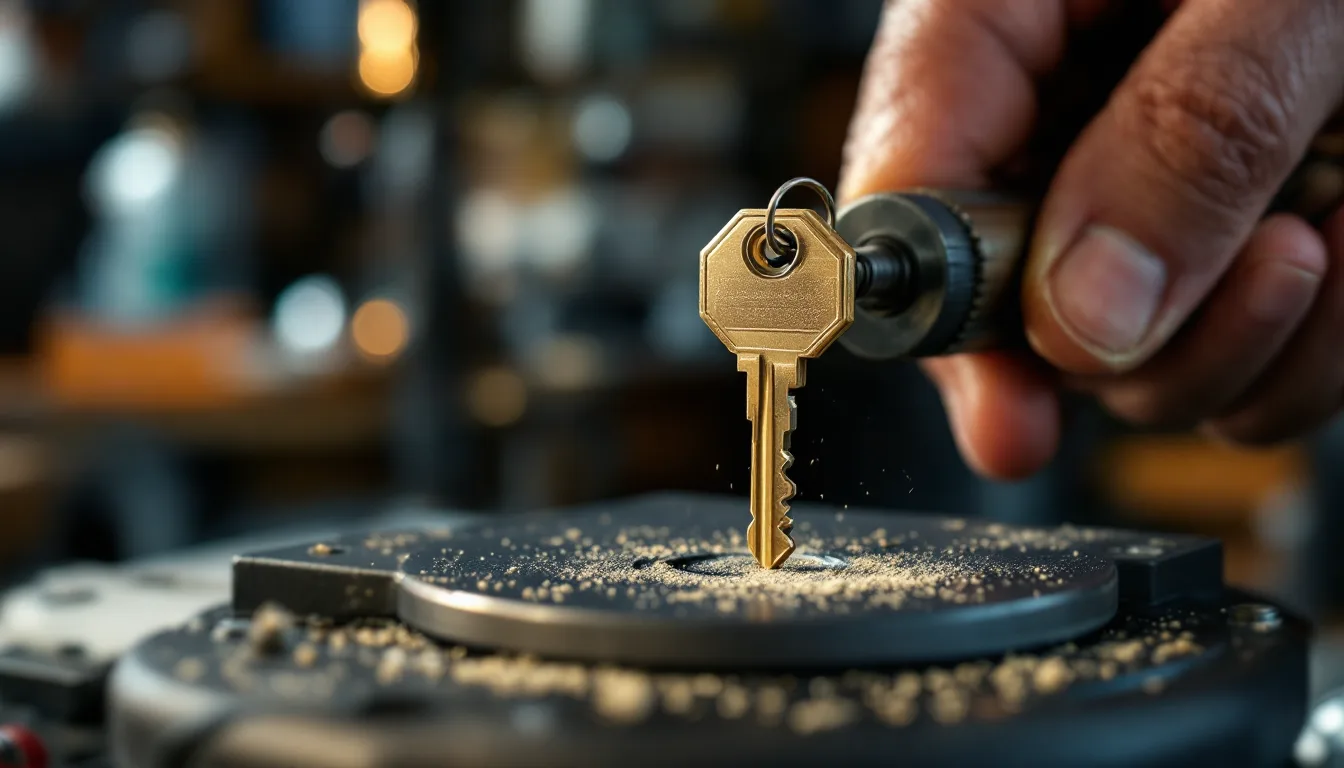
Why do so many duplicate keys fail to work?
Most people only think about key duplication when something goes wrong. The copy sticks in the lock, turns halfway, or works for a month and then quits. Nearly every one of those failures traces back to a few causes, and knowing them makes it easier to end up with a copy that behaves like the original.
The first cause is a worn original. A key that has been used for years has had its cuts rounded off. A copy made from it inherits that wear and adds a little error of its own. Copy the copy and the errors stack up. The second cause is the wrong blank. Keys that look alike can differ in groove pattern or length by a hair, and a blank that is close but not correct will cut cleanly and then fail in the cylinder. The third cause is a cutting machine that is poorly set, where the key sits a fraction off in the vise and every depth comes out slightly wrong.
The fourth cause has nothing to do with the key. Sometimes the lock is the problem and the key is taking the blame. A dirty, worn, or sticky cylinder will make even a perfect copy feel bad, and a wood door that has swollen in summer heat can make a bolt bind in the frame, which feels a lot like a key problem. Part of our job is telling you which one you actually have, before you spend money on a copy that was never going to fix it.
How do we duplicate a key, step by step?
Cutting a key is quick work, but the quality sits in the small steps around the cut. This is how we approach a copy, whether it happens at our Westwood storefront or from one of our mobile service vans.
- Look at the original. We check the condition of the cuts, the brand and markings on the bow, and the shape of the blade, so we know which keyway and which blank it belongs to.
- Decide whether it can be copied here. Some keys are restricted, some are high-security, and some vehicle keys contain a transponder chip. We tell you plainly which category yours falls into before anything is cut.
- Match the blank. We pick a blank that fits the same keyway and length as the original, not just one that looks close.
- Cut it carefully. The original is clamped square in the machine so every depth and spacing lands where it should. If the original is too worn to trust, we say so and talk through other ways to get a clean key.
- Clean up the edges. A freshly cut key has burrs that can scratch the pins inside your lock and make the key feel gritty, so we remove them.
- Test it in the lock. A good copy goes in smoothly, turns without forcing, and pulls the bolt fully. On a deadbolt we try it with the door open and again with the door closed, because a tight door can hide a weak copy.
Locked out or need a locksmith now?
We answer around the clock, every day of the year.
Call (213) 577-1366What kinds of keys can we copy?
Most everyday keys are straightforward. Others come with conditions, and we would rather explain those up front than surprise you at the counter. Here is how the common types break down.
- House keys and spare house keys: standard residential keys for entry doors, back doors, and side gates are the bulk of what we copy.
- Duplicate deadbolt keys: deadbolts often use a different keyway from the knob below them, so we cut each key from its own blank rather than assuming they match.
- Apartment key copies: unit keys for mid-size and small buildings. Some buildings restrict copies, so we may ask about the building's rules before cutting.
- Office and commercial key duplication: suite doors, storage rooms, cabinets, and shop doors. Larger sets tied to a master key system need extra care, covered below.
- Mailbox key duplication: small, often unusual keys that are easy to lose. If the lock itself is the problem, replacement may be the better route.
- High-security and restricted keys: copied only with the proper authorization, which we explain in its own section.
- Vehicle keys: a metal-only car key can sometimes be cut like any other. A key with a chip generally needs programming as well, and we confirm by VIN or in person what your specific vehicle requires.
What affects the cost of key duplication?
We do not quote numbers on a web page, because the honest answer depends on what is in your hand. What we can do is tell you exactly what moves the cost up or down, so there are no surprises when you call.
- Key type: a plain brass house key is the simplest and usually the more economical route. Specialty blanks, high-security keys, and keys with electronics cost more because the blanks and the work are different.
- Blank availability: older or unusual keys sometimes need a harder-to-find blank, and that affects both the cost and how long it takes to complete.
- Condition of the original: a worn key may need extra attention, or we may recommend a different approach rather than copying wear into a new key.
- Quantity: cutting several keys from one setup is generally more efficient than coming back repeatedly for one at a time.
- Where the work happens: bringing a key to our storefront is the lighter-cost option for most standard keys. Having a technician come to you adds a service component for the trip.
- Time of day: our line is open around the clock, but after-hours and holiday calls are priced differently from a daytime visit.
Locked out or need a locksmith now?
We answer around the clock, every day of the year.
Call (213) 577-1366Can you copy a key marked 'Do Not Duplicate'?
This is one of the most common questions, and the answer is less simple than people expect. A 'Do Not Duplicate' stamp is usually a request from the owner or manufacturer, not a physical barrier. It does not stop a machine from cutting the key, but it is a good reason for a legitimate locksmith to ask a few questions first. We will ask who the key belongs to and whether you have the right to copy it. For a business key or a building key, that often means getting permission from the property manager or owner.
Restricted keys are a different matter. These are keyways protected by a manufacturer or a patent, and blanks are only released against a signed authorization or a card tied to the account holder. If your lock is that type, we cannot simply cut a copy on the spot, and anyone who says they can without any paperwork is probably using a lookalike blank that will not behave properly. Our high-security lock options page explains how these systems work and why they exist.
If you manage an office or small building with a master key system, the rule of thumb is the same. Copies should come from someone who controls the system, and the list of who holds which key matters as much as the keys themselves. If you are thinking about restructuring who can open what, a master key system is a better conversation than a pile of loose copies.
Key duplication around San Fernando: bungalows, storefronts, and the Mall
San Fernando is a compact, independent city of about 2.4 square miles, and its housing stock shapes what comes through our door. A lot of the city is early-1900s bungalows, Spanish-style cottages, and postwar homes on small lots, with small apartment buildings near the downtown mall. Many of the older homes still have their original door hardware. That is charming, but it makes key duplication a bit more particular than in a new tract house. Old keys have had decades of wear, and the blanks for older locks are not always sitting on a shelf. We check the key against the lock before cutting, and we are honest if a better answer is to bring a good original forward rather than copy a tired one.
Think of a bungalow near Las Palmas Park where the family has three keys for one front door, and each one is a copy of a copy. The door works, but only if you jiggle the key. That is the classic situation where a single clean copy from the best surviving key, or a fresh start through rekeying, saves a lot of frustration. Security screen doors are another common sight on pre-war homes in the 91340 ZIP code. They often have their own lock and their own key, which people forget to copy until the day they need it. If you have a screen door with a key, make a spare of it at the same time as the main door.
Around the Maclay Avenue corridor, the Truman Street and San Fernando Road corridor, and the San Fernando Mall, the keys are more likely to be business keys. Storefronts line those streets, and shop owners tend to need duplicates for employees, for a back door, for a rolling gate, or for a cash drawer. If a lock on a shop door is sticking and a new key will not fix it, the problem may be the hardware, and our storefront lock repair page covers that side.
The weather matters too. Hot summers in this part of the northeast Valley make wood doors and frames expand, and Santa Ana wind events push dust into exterior cylinders. Dust is hard on keys and locks alike, because it packs into the pins and makes a new key feel rough. If a fresh copy sticks a few days after cutting, a dirty cylinder is a likely suspect, and a cleaning is a better answer than another key. Winters here are mild with little corrosion risk, so rust is rarely the cause of a key that will not turn.
Other parts of town come up in conversation as well, including the Civic Center area, the Recreation Park and Pioneer Park areas, and the streets near the Sylmar/San Fernando Metrolink Station. Commuters who leave a car near that station sometimes ask about a spare vehicle key for the glove box at home. A spare is worth having before you need one, but if the key has a chip, it needs programming as well as cutting, and we confirm that for your vehicle by VIN or in person. See our transponder key programming page for how that works.
Locked out or need a locksmith now?
We answer around the clock, every day of the year.
Call (213) 577-1366Do we come to you for mobile key duplication?
Often, yes. Wilshire Lock & Key has a storefront at 10740 Wilshire Blvd in Westwood and mobile service vans, and San Fernando is about 23 miles from our base. For a single standard key, driving over to the storefront can be the lighter-cost option. But there are plenty of cases where a visit to you makes more sense: you cannot leave a shop unattended, the key belongs to a door you need to test on-site, or you need several keys for a rental or an office and want each one tried in its own lock.
Whether we can cut at your door or whether a particular key has to come back to the storefront depends on the key. A common house key is one thing. A high-security key or a key that needs special authorization is another. We will tell you on the phone which it is. Our mobile locksmith page describes how a visit works in general.
When a copy is not the right answer
A duplicate is the right call when you have a working key and want more of them. It is the wrong call in a few situations, and we would rather say so than cut a key that does not solve your problem.
If you have lost a key and do not know where it went, a copy of your remaining key does not make your home any safer, because whoever has the lost one can still use it. In that situation, rekeying the lock so the old key stops working is generally the better move, and it is usually a more economical route than replacing the lock entirely. If a key has broken off in the lock, copying is not the first step either. Getting the broken piece out comes first.
If you are a landlord or manager with many units, a pile of unrecorded copies is a security problem waiting to happen. And for a mailbox, if the lock is worn or the key is gone with no original to copy from, you may be looking at mailbox lock replacement rather than duplication. For the broader picture of home security work in the city, our San Fernando locksmith hub lists the full range.
Why call Wilshire Lock & Key for key duplication?
Key duplication looks simple, and it is when it is done carefully. We do it the same way each time. Here is what we can honestly offer.
- In business since 1987. That is a lot of keys, and a lot of lessons about which blanks fit and which only look like they do.
- A real storefront and mobile vans. You can come to us at 10740 Wilshire Blvd in Westwood, or have a van come to you in San Fernando.
- One company, no dispatch middlemen. The person who answers the phone is part of the company that does the work. We do not pass your call to a stranger who has never heard of us.
- David's oversight. David, the owner and lead technician, stands behind how the work gets done.
- Always answered. Our phone, (213) 577-1366, is answered 24 hours a day, 7 days a week, year-round, so a lost spare at midnight is not something you have to wait on.
- Straight answers about what can and cannot be copied. If your key is restricted or has a chip, we say so up front.
Locked out or need a locksmith now?
We answer around the clock, every day of the year.
Call (213) 577-1366A note on locksmith licensing in California
California requires locksmith companies to hold a license from the Bureau of Security and Investigative Services, known as a BSIS LCO license. It is reasonable to ask any locksmith you call, including us, for that license number before work begins. Key duplication is a small job, but it is also how someone gets access to your door, so it is fair to ask who is making your keys. If you have a question about how we handle a particular key, reach out through our contact page or call us directly.
Frequently asked questions
Can you copy any house key?
Most standard house keys can be copied without trouble. The exceptions are restricted keys, high-security keys, and keys with chips. Those either need authorization or additional programming. If you tell us what the key looks like or read us the markings on it, we can usually say on the phone whether it is a simple copy.
Is it better to copy my original key or an existing copy?
Always start with the original, or the least-worn key you have. A copy made from a copy inherits the wear and the cutting errors of the one before it. If every key you own is a copy, bring the cleanest one and we will check it against the lock before cutting.
Why does my new copy stick or not turn?
There are a few possibilities: the wrong blank, a small cutting error, burrs left on the key, or a lock that is dirty or worn. In San Fernando, dust from Santa Ana wind events can pack into exterior cylinders. Bring the copy and the original in and we will find out whether the key or the lock is the problem.
Can I copy a key that says 'Do Not Duplicate'?
The stamp is usually a request, not a lock on the key. We will ask whether the key is yours or whether you have permission to copy it, which is especially important for business or building keys. A restricted key is another matter and requires authorization from the account holder before blanks can be released.
Can you duplicate a car key?
It depends on the key. A plain metal key can sometimes be cut like any other. A key with a transponder chip also needs to be programmed to the vehicle. We confirm what your specific car needs by VIN or in person, and where a dealer is the only route, we will say so honestly.
Do you copy mailbox keys?
Yes, as long as we can match the blank. Mailbox keys are small and easy to lose, so it makes sense to copy one while you still have it. If the lock has been lost or damaged and there is no original, replacement may be the better option than copying.
Can you make duplicate keys for my office or shop?
Yes. For ordinary business keys, we cut them like any other. If your doors are part of a master key system, or the keys are restricted, copies should come through whoever controls the system. For storefronts along Maclay Avenue or San Fernando Road, tell us which doors you need and we will advise on the best way to handle the set.
Can someone come to me for key copying, or do I have to bring the key in?
Both are possible. You can come to our Westwood storefront, or we can send a mobile van to San Fernando. Whether a given key can be cut at your door depends on the key type, and we will tell you when you call (213) 577-1366.
What does key duplication cost?
We do not post prices because they depend on the key. The main factors are the type of key, how easy the blank is to get, the condition of the original, how many copies you need, and whether we come to you. When you call, describe the key and we will explain what applies.
More locksmith help in San Fernando
Key Duplication near San Fernando
Reviewed by David, Owner & Lead Technician, Wilshire Lock & Key — in the locksmith trade since 1987.
Last updated 2026-10-11.