
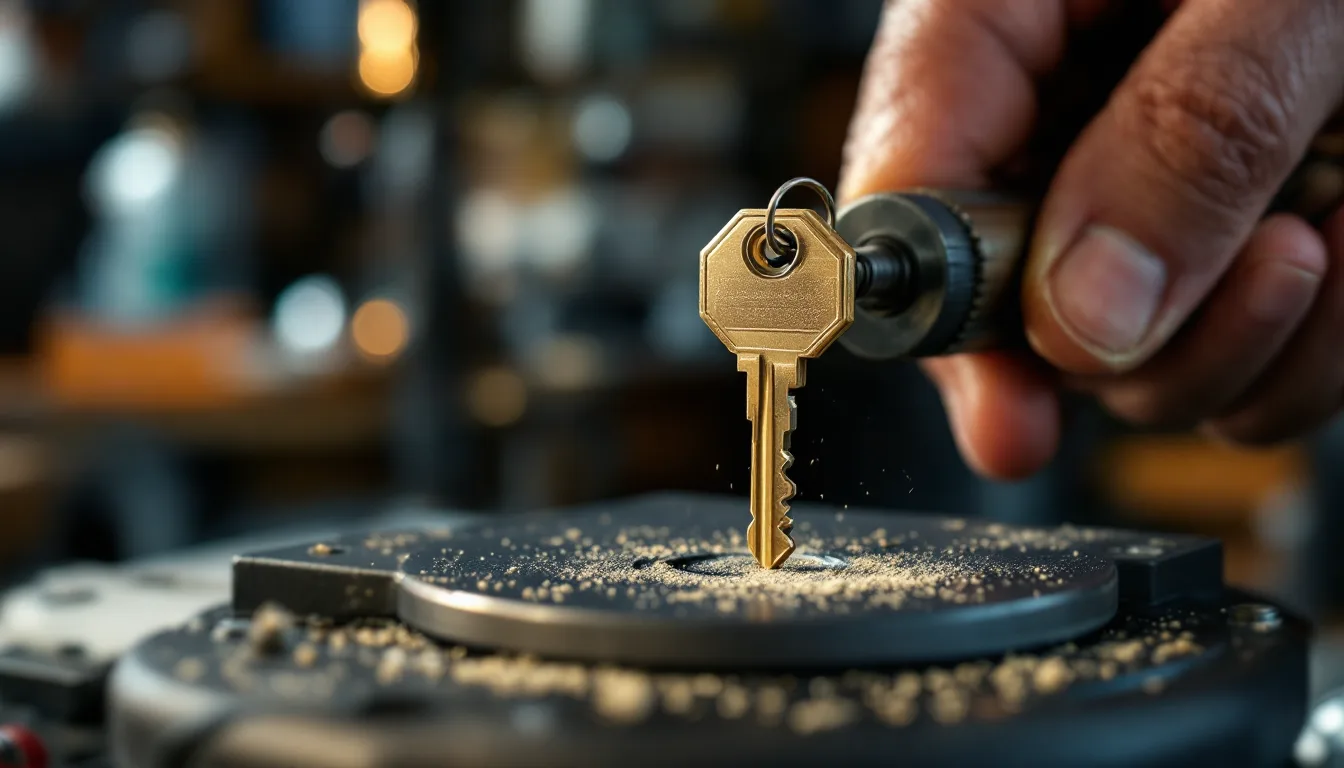
What does good key duplication actually involve?
Copying a key looks like the simplest job in the trade: one key goes into the machine, another comes out. Whether that second key works smoothly comes down to details. A key is a code cut in metal. The depth and spacing of each cut lift the pins inside the lock to exactly the right height, and if a cut is off by even a few thousandths of an inch, the key may bind, turn only with a jiggle, or not turn at all.
Most bad copies trace back to three things: a worn original, the wrong blank, or a copy made from a copy. Every generation of copying adds a little error, and a key that has ridden on a ring for fifteen years has rounded edges that a machine will faithfully reproduce. That is why we look at the original before we cut anything, match it to the correct blank, and test the result in the lock whenever the lock is available.
This page covers key duplication for house, apartment, office, and mailbox keys, including restricted and high-security systems where the rules are different. Keys with a transponder chip, such as most modern car keys, are a separate job. If that is what you need, start with car key replacement, where we confirm what a vehicle needs by VIN and in person rather than guessing.
Why do Mission Hills homes so often need spare keys?
Mission Hills is mostly 1950s single-family ranch tracts on modest lots, and plenty of unremodeled homes still have their original postwar door hardware. A house that has been lived in for decades tends to have a messy key history: the original set, copies of copies, a key with a neighbor, one that a past contractor or tenant never returned. Nobody is quite sure how many are out there.
Older hardware cuts both ways for duplication. Postwar locks usually use common keyways, so blanks are easy to find and the copy itself is rarely complicated. But decades of daily use wear down pins and cylinders, and a worn lock can make even a flawless copy feel stiff. When that is the real problem, we say so instead of simply cutting another key and sending you off to struggle with it. Sometimes the honest fix is a lock repair or a fresh cylinder, not more keys.
Home sales are the other common trigger. When a house changes hands, the new owner usually wants spare house keys for the family and also wants to know the previous owner's copies no longer work. Those are two different jobs. If you cannot account for who holds the old keys, rekeying the locks makes every old key useless, and we then cut your new copies from the new key. Duplicating first and rekeying later just means paying to copy keys you are about to retire.
Locked out or need a locksmith now?
We answer around the clock, every day of the year.
Call (213) 577-1366How do we copy a key, step by step?
Here is what happens when you bring us a key at the storefront, or when we come to you in a mobile van:
- Identify the key and the lock. We read the brand stamped on the head, the keyway profile, and any restriction markings, and ask what the key opens: a front door knob, a deadbolt, a padlock, an office door, a mailbox.
- Inspect the original. We check for bends, cracks, rounded cuts, and a worn tip. A key that is already failing should not be the pattern for a new one.
- Match the blank. The blank must have the right keyway, length, and shoulder or tip stop. A near-match is the most common reason a copy that looks identical will not turn.
- Cut the key. Depending on the key, we cut by tracing the original, by code, or by decoding it first, then remove the burrs so the key slides in cleanly and does not shed brass into your lock.
- Test it. If the lock is in front of us, we run the new key through it several times, checking that it enters, turns, and retracts the latch or bolt fully. On a deadbolt we test it from both sides where the hardware allows.
- Fix what does not pass. A copy that binds gets recut. If the lock itself is the culprit, we tell you plainly and explain your options.
- Hand back the original and the copies, and mark which is which if you ordered more than one.
Which kinds of keys can we duplicate?
Most keys are straightforward. Some come with conditions, and we would rather explain them up front than surprise you at the counter.
- House key copy and spare house keys: standard pin-tumbler keys for entry knobs and levers. These are the most routine copies we make.
- Duplicate deadbolt key: a deadbolt often has a different keyway than the knob above it, so bring every key on the ring or tell us which lock each one belongs to. Cutting the wrong blank is an easy mistake to avoid.
- Apartment key copy: whether you may copy an apartment key depends on your lease and building management. If a key is stamped as not to be duplicated, that stamp is a request rather than a mechanical barrier, and we will ask a few questions before cutting. Many buildings simply want tenants to go through management.
- Office key duplication and commercial key duplication: we can cut keys for offices, suites, storage rooms, and back-of-house doors. If a business has lost track of who holds what, we can talk about moving to a master key system instead of continuing to copy loose keys.
- Mailbox key duplication: small flat keys are quick to cut. Some mailbox locks are controlled by the post office or building management, and we cannot copy those without proper authority. If the lock itself has failed or the key is lost, mailbox lock replacement is the usual route.
- High security key duplication and restricted key duplication: patented and restricted keyways are built so that copies are controlled. We can often help, but expect us to ask for authorization such as a key card or proof you are entitled to the key, and be aware that some copies must be ordered through the manufacturer's channel rather than cut on the spot. Our high-security locks page explains how these systems work.
Locked out or need a locksmith now?
We answer around the clock, every day of the year.
Call (213) 577-1366What affects the cost of key duplication?
We do not publish numbers on a page because the honest answer depends on the key in your hand. These are the things that move the cost up or down:
- The key type. A common brass house key is the lighter-cost end of the range. Restricted, high-security, and specialty keys use costlier blanks and more careful work.
- Blank availability. A common blank is on the shelf. A rare or manufacturer-controlled one may have to be ordered.
- How many copies you need. Cutting several keys in one visit is usually more economical per key than coming back repeatedly.
- Condition of the original. A clean original is simple to trace. A worn one may need to be decoded or originated from the lock, which takes more work.
- Where and when. Bringing a key to the storefront is generally the more economical route. A mobile visit adds travel, and a late-night or holiday call is priced differently from a daytime one.
- Whether the lock needs attention. If the copy will not work smoothly because the cylinder is worn, a repair or rekey is a separate decision from the copy itself.
Can you copy keys at my door with mobile key duplication?
Often, yes. Our mobile vans can handle many common house and office keys on site, which is useful if you cannot leave a building, you are managing several doors at once, or you want to see the copy tested in the actual lock. Mission Hills is about 17 miles from our Westwood storefront, and we cover it as part of our service area across Los Angeles and Ventura counties. Our mobile locksmith page covers how those visits work more broadly.
Some jobs are better handled at the storefront or need a manufacturer order first, particularly restricted and high-security keys. If you call us at (213) 577-1366, we will tell you which route fits your key before anyone drives anywhere. That saves you a wasted trip, and it saves us a wasted one.
The phone is answered around the clock, every day of the year, so a request for a spare key at an odd hour reaches a person. Whether the cutting happens that moment or at the next practical opportunity depends on the key, and we will be straightforward about it.
What does key duplication look like around Mission Hills?
Mission Hills, ZIP code 91345, is a mix of neighborhoods, and the key situation changes from one to the next.
Around the Mission district near San Fernando Mission and in the Brand Park area, the housing is mostly those 1950s ranch tracts. The typical request is a set of spare house keys for a family, or a full set of copies after a sale, often with original postwar hardware still on the door. Home rekeys after a sale are one of the most common scenarios here, and duplication is the second half of that job: once the locks are rekeyed, you get fresh copies for everyone who needs one, cut from the new key and tested before we leave.
Along the Sepulveda Boulevard corridor, apartments are more concentrated, and an apartment key copy raises different questions. Is the key restricted by the building? Does management want a record? A tenant who needs a spare cut should check with the property first. If you are already locked out, that is a different problem, and our apartment lockout page covers it. Near Rinaldi Street, where there is some newer townhome development, the hardware can differ from the postwar locks nearby, so bring the key and we will identify the right blank rather than assume.
Businesses along Devonshire Street and around Providence Holy Cross Medical Center tend to ask for office and commercial key duplication: extra keys for staff, suite doors, supply rooms, and file storage. Those doors often have panic hardware and closers as well, and if you are also dealing with worn hardware, our commercial door hardware work is a separate service from copying keys. Anyone with employees should also keep a simple log of who holds which key, since a copied key you cannot trace is a weak spot.
Climate plays a small role. Mission Hills runs hotter in summer than the basin, and the area near the 118 corridor sees periodic Santa Ana winds that dry out door seals and weatherstripping. A door that drags or sticks against the strike plate often gets blamed on the key. We check the door and latch alignment before concluding the copy is the problem.
Locked out or need a locksmith now?
We answer around the clock, every day of the year.
Call (213) 577-1366When is a copy not the right answer?
Copying a key duplicates access. It does not fix who has access, and it does not repair a failing lock. A few situations call for something else:
If you have lost a key and do not know where it went, or a former tenant, employee, or contractor still has one, a copy does nothing for your security. A rekey does. If you are locked out entirely, that is a lockout call, not a duplication call. If a key has snapped in the lock, that needs extraction before anything can be copied. And if a key turns only with effort, no copy will solve it until the lock is looked at.
We would rather steer you toward the right fix than sell you another key. That is also the more economical route more often than people expect.
Why call Wilshire Lock & Key for key duplication?
We have been in business since 1987, and key cutting is one of the oldest skills in the trade. We run a real storefront at 10740 Wilshire Blvd in Westwood alongside our mobile vans, so there is a physical shop behind the van that shows up at your door. When you call (213) 577-1366, you reach our company. We do not route you through a dispatch middleman who sends a stranger.
David, the owner and lead technician, oversees the work. That matters most on the unusual jobs: restricted keyways, worn originals, and systems where the right answer is not just to cut and go.
One honest note about hiring any locksmith: California requires locksmith companies to hold a BSIS LCO license, and you should ask any locksmith you hire for their license number before they start. That is a fair question and a good habit.
We cover 140 cities across Los Angeles and Ventura counties, and Mission Hills is one of them. Whether you need a single spare house key, a stack of keys for an office, or advice on a restricted system, the call is the same: tell us what the key opens, and we will tell you what is possible.
Frequently asked questions
How many copies of a key can I get at once?
As many as you need, within the limits of the key. Common house and office keys can be cut in any quantity. Restricted keys may require authorization for each copy. If you are cutting many keys, tell us up front so we can test each one and mark which belongs to which lock.
Why does my new copy stick or fail to turn?
Usually one of four reasons: the blank was a near-match rather than the right one, the original was worn and the copy inherited the wear, the burrs were not cleaned, or the lock itself is worn. Bring both keys and the lock if you can. We will find which cause it is and recut or repair as needed.
Can you copy a key stamped 'Do Not Duplicate'?
That stamp is a request, not a mechanical block, but we do not copy keys carelessly. We will ask a few questions about whose key it is and what it opens. For apartments and workplaces, management often wants to handle copies. For true restricted systems, we will ask for proper authorization.
Can you make a key if I do not have the original?
Sometimes. If the lock is in front of us, we can often originate a key from it. In other cases a key code, a card, or manufacturer information is needed. It depends on the lock and how it was built, and we will tell you what is possible after seeing it.
Do you copy mailbox keys?
Yes, for mailboxes where the lock is not controlled by the post office or building management. Some mailbox locks can only be keyed through those parties. If the lock is damaged or the key is lost and cannot be copied, we can talk about replacing the lock.
How do I know if my key is high security or restricted?
Look at the head of the key for markings such as a patent notice, a restricted-key stamp, or an unusual shape, and notice whether the blade has dimples or a side milling rather than just edge cuts. If you are unsure, bring it in or call (213) 577-1366 and describe it. We confirm by looking at the key itself.
Can you come to my Mission Hills home or office to cut keys?
Often, yes. Our mobile vans can cut many common house and office keys on site. Restricted or high-security keys may need the storefront or a manufacturer order. Call us and describe the key, and we will tell you the right route before anyone makes the trip.
Should I copy my key or rekey my locks after buying a house?
If you do not know who holds the old keys, rekey first, then copy the new key for your family. Copying existing keys just spreads access you cannot account for. If you know the keys are all accounted for and only need spares, a simple copy is enough.
More locksmith help in Mission Hills
Key Duplication near Mission Hills
Reviewed by David, Owner & Lead Technician, Wilshire Lock & Key — in the locksmith trade since 1987.
Last updated 2026-10-11.