
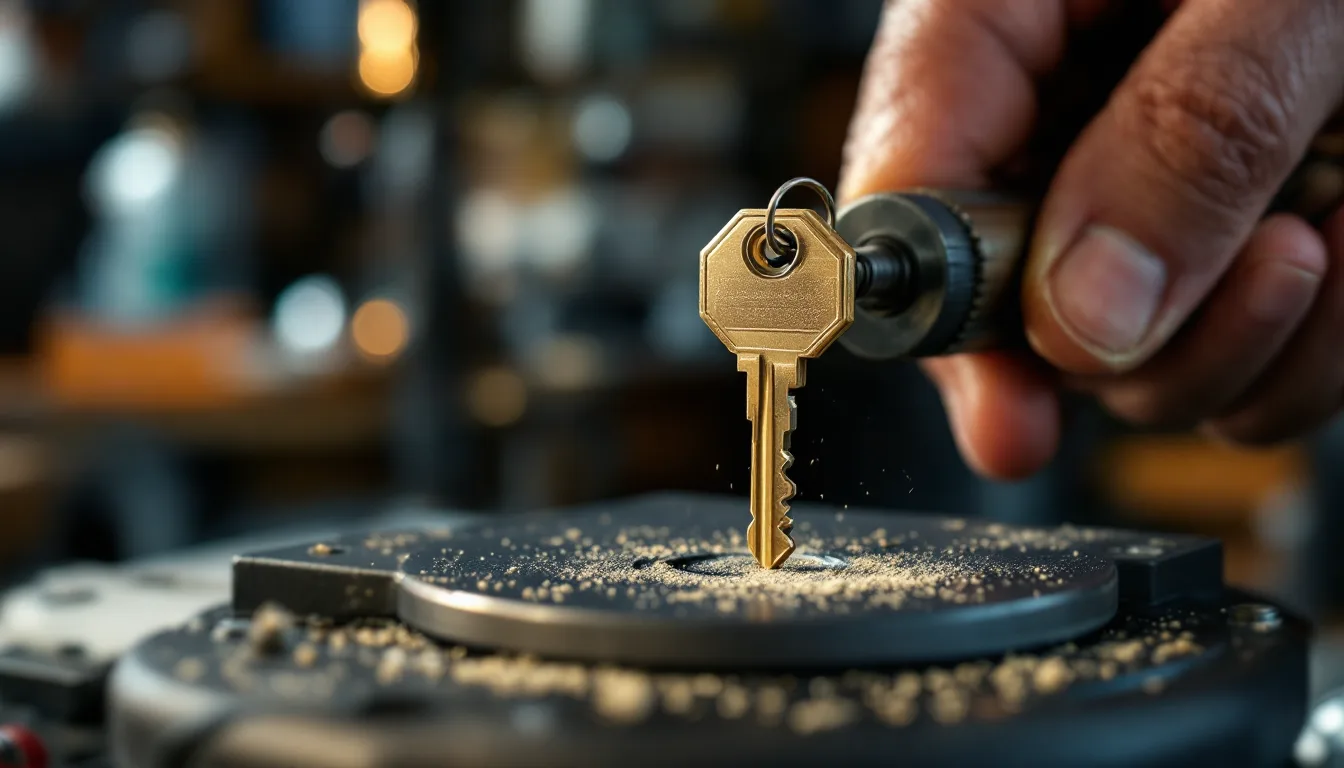
Why do copied keys stop working so often?
Most bad copies are copies of copies. A key that has been duplicated, worn down in a lock for years, then duplicated again carries every small error forward. The cuts get a little shallower, the shoulders drift a little, and eventually you own a key that turns only if you jiggle it and lift the door at the same time. When that key finally refuses to turn, people assume the lock is failing. Very often the lock is fine and the key is the problem.
Other causes are simple. The blank might be wrong, since many keys look alike and are not. The cutting machine might have been out of adjustment. Burrs left on the edges can chew up the pins inside a cylinder. Or the key was cut to the nearest similar profile instead of the exact one. Good key duplication is mostly care: matching the blank, cutting from the best original available, cleaning the edges, and checking the result before it leaves our hands.
If you are down to one working key for a door, the most useful thing you can do is get a clean copy made before that key wears any further. Keep the original as your reference key and never cut new copies from a copy. If a key has already snapped in a lock, that is a different job, and we cover it under broken key extraction in Covina.
How do we duplicate a key, step by step?
The process is not complicated, but each step is where a copy either comes out right or comes out frustrating. Here is how we work, whether you are at our Westwood storefront or we are with you in Covina.
- Identify the key. We read the stamping, the shape of the blade, and the cuts to find the correct blank and keyway. If you can tell us which lock it operates, that helps us confirm.
- Check the condition of the original. If the key is badly worn, we will tell you plainly and suggest cutting from the least worn key you own instead of the one that looks most convenient.
- Check whether it is restricted. Some keyways are controlled, and we handle those differently. More on that below.
- Match the blank and cut. The blank has to fit the keyway and the cut depths have to follow the original precisely.
- Deburr and clean the new key. Rough edges are one of the most common reasons a fresh copy feels gritty or wears the lock early.
- Test it. When we are at the door, we try the copy in the actual lock. At the storefront, we compare it against the original and make sure it enters and turns smoothly.
- Hand it back with advice. We will tell you which key is the reference key to keep safe and which is the working copy.
Locked out or need a locksmith now?
We answer around the clock, every day of the year.
Call (213) 577-1366What kinds of keys can we copy?
Most keys people bring us are ordinary, and ordinary keys are quick work. But the category is wider than it first appears, and each type has its own wrinkle.
- House key copy and spare house key: standard residential keys for entry doors, back doors, and side gates, cut accurately so each one turns as easily as the original.
- Duplicate deadbolt key: deadbolts often use a different keyway from the knob or handle set on the same door, so we match each key to its own lock instead of assuming they are the same.
- Apartment key copy: unit keys for front doors, plus building entry, laundry, and storage keys. Some of these are restricted and need authorization from the property manager.
- Office key duplication and commercial key duplication: suite doors, file cabinets, desks, and back-of-house doors, including larger sets for staff.
- Mailbox key duplication: the small flat keys for cluster and wall-mounted boxes. If your mailbox lock is damaged or the key has been lost for good, replacing the lock may make more sense, and we handle that under mailbox lock replacement.
- High security key duplication: keys with tighter tolerances, unusual profiles, or added security features. Our overview of high-security locks explains why these systems are built the way they are.
- Restricted key duplication: keys on controlled keyways, which we copy only when ownership or authorization can be properly established.
What is a restricted key, and why can't I copy it anywhere?
A restricted keyway is one where the manufacturer limits who can get blanks and key copies. The point is control: if anyone with a few minutes at a hardware store could copy your key, the extra security would mean nothing. Many high security cylinders work this way, and so do some office and apartment building systems.
A stamp reading 'Do Not Duplicate' is a different thing. It is a request, not a lock on the blank, and a stamped key may still be copyable. We take that stamp seriously anyway. If a key is stamped that way and belongs to a building or business that is not yours, we will ask you to confirm you have permission before we cut it. That is not us being difficult. It protects the person who handed you that key.
For a true restricted system, expect a conversation about who owns the lock, and possibly a delay while authorization is confirmed. We would rather tell you that up front than have you wait on a copy we cannot responsibly make. Some electronic and vehicle keys also cannot be treated like a simple cut. We confirm those by VIN or in person, and some situations may be dealer-only. We will say so honestly if that is the case.
Locked out or need a locksmith now?
We answer around the clock, every day of the year.
Call (213) 577-1366What affects the cost of key duplication?
We do not quote numbers on a web page, because the honest answer depends on the key in your hand. These are the real factors:
The type of key and blank is the biggest one. A standard residential key uses a common blank and a short cutting process. A high security or restricted key uses a more specialized blank and takes more careful work, so it costs more to produce.
Quantity matters. Cutting several copies of the same key in one visit is usually the more economical route than coming back for them one at a time.
Condition of the original matters too. A worn or bent key can take extra effort, or we may recommend a different approach, such as cutting from another key you own or addressing the lock itself.
Location and timing also play a part. Bringing a key to the storefront is the lighter-cost option compared with arranging a mobile visit, since a mobile visit means a van traveling to you. After-hours requests are handled differently than a daytime visit.
If you call (213) 577-1366 and describe the key, we can tell you which of these factors apply to you before you commit to anything.
Can you come to me for mobile key duplication?
Yes, in many cases. Our mobile service vans work across Los Angeles and Ventura counties, and Covina is within our service area. Our storefront is in Westwood, roughly 32 miles from Covina, so for mobile visits we talk through the job on the phone first and plan from there. That conversation also lets us tell you whether the key can be handled at your door or whether it is better to bring it to the storefront.
Mobile makes sense when you have a lot of keys to cut, when several locks need to be checked at once, when you cannot leave a business or property, or when you are dealing with a gate or door where testing the copy in place matters. It is less important for a single, ordinary house key that you can bring in. Our page on mobile locksmith service in Covina explains how the vans work in general.
Key duplication around Covina: older doors, ranch tracts, and gated lots
Covina is a city of different housing eras, and the key problems follow the houses. Near Downtown Covina and the Citrus Avenue district, older Craftsman-era and early-20th-century homes survive. Those doors often carry old hardware, sometimes a mix of original and later replacement locks, so a single door can have keys that do not look like each other. We find it worth identifying every key on the ring before cutting copies. Some of those old doors are also candidates for hardware upgrades, and a conversation about copies often turns into a conversation about what should be replaced instead.
Hot, dry summers on this side of the San Gabriel Valley also matter. Heat can make older wood doors bind seasonally, especially near downtown. When a key seems stiff in July and fine in November, people blame the key and request a new copy. A new copy will not fix a door that has swollen against its frame. We check for that before cutting, which saves you a visit and a pointless key.
Surrounding downtown are the 1950s and 1960s ranch tracts, where families have lived long enough to accumulate worn spares. A key that has been copied from a copy and kept in a kitchen drawer for decades is a common find in these houses. Cutting a fresh first-generation copy from a clean original resets that chain.
Covina Hills, in the southeast, is a different picture: larger, semi-rural lots, many with gated driveways. Those properties tend to have more keys per household, including house, side door, outbuilding, and gate keys. A gate key that has worn out is better dealt with by repairing the gate lock, which we cover under gate lock repair. For copies, it helps to tell us up front which keys go to which door so nothing gets mixed up.
Apartment complexes line the Arrow Highway corridor and parts of Azusa Avenue. Tenants there usually need a spare unit key or a copy of a mailbox key, and the building's own rules decide what is allowed. If you manage rentals, our page on locksmith services for landlords covers how we help with sets of keys across units. Along Badillo Street, you will find a mix of residential and business needs, and the same questions apply.
Whether your address falls in ZIP code 91722, 91723, or 91724, or in the adjacent Charter Oak area with Covina addresses, the starting point is the same: tell us what the key opens and where you are, and we will tell you how we would handle it. Commuters who park at the Covina Metrolink Station also tend to benefit from a spare house key kept somewhere safe, rather than discovering at the end of a long day that the only key is in the wrong place.
Locked out or need a locksmith now?
We answer around the clock, every day of the year.
Call (213) 577-1366Office and commercial key duplication in Covina
Business keys carry more risk than house keys. Someone leaves, a key stays with them, and suddenly a back door that the whole team relies on is a question mark. For storefronts and restaurants in the downtown Citrus Avenue district, front and rear door keys, stockroom keys, and cash drawer keys often travel through many hands, which is where duplication habits matter.
For commercial key duplication we recommend three simple habits. First, keep a record of who holds which key. Second, make copies only from a clean reference key, never from an employee's well-worn working copy. Third, if the number of keys has grown past what you can track, consider whether the system should change. A master key system lets different people open different doors with different keys, and it can be cleaner than copying the same key over and over.
If your keys are on a restricted keyway, we will ask for authorization from whoever controls the system. For an owner or manager, that is usually a short conversation.
Why call Wilshire Lock & Key for spare keys?
Key cutting sounds like a small job, and in many cases it is. What makes the difference is who does it and how much care goes into it. Here is what we can honestly offer:
- We have been in business since 1987. That is a long time to see every way a key can go wrong.
- We have a storefront at 10740 Wilshire Blvd, Los Angeles, CA 90024, and mobile vans. You can come to us or have us come to you.
- You deal with one company. There are no dispatch middlemen between your call and the technician.
- David, the owner and lead technician, oversees the work. Questions about a tricky key do not get passed along a chain.
- We answer the phone 24 hours a day, 7 days a week, all year, at (213) 577-1366.
- We serve 140 cities across Los Angeles and Ventura counties, including Covina.
When is a copy not the right answer?
Sometimes the honest recommendation is to skip the copy. If you have lost a key and do not know where it went, another copy leaves the missing key in the world. In that case, rekeying the lock changes the lock so the lost key no longer works, and it is often a better use of money than adding keys to a system you no longer trust. The same applies after a breakup, a tenant move-out, or a departing employee.
If a key sticks, spins, or needs force, bring that up when you call. We would rather diagnose the lock than sell you a copy of a key that is not the real problem.
Keep in mind that California requires locksmith companies to hold a BSIS LCO license, and you should ask any locksmith you hire about it. That is a fair question for any company that will hold a copy of access to your home or business.
Frequently asked questions
Can you copy a key at night or on a weekend in Covina?
Our phone is answered 24 hours a day, 7 days a week at (213) 577-1366. Call and describe the key, and we will tell you how it can be handled, whether through a mobile visit or a trip to our Westwood storefront.
Can I get a duplicate deadbolt key if I only have the knob key?
Not necessarily. Deadbolts and knob locks on the same door are often keyed differently. We identify which lock each key belongs to and match the right blank to each one.
My key is stamped 'Do Not Duplicate.' Can you still copy it?
That stamp is a request from the owner, not always a physical barrier. We take it seriously, so we will ask you to confirm you have permission, especially for apartment, office, or building keys. A truly restricted keyway needs authorization.
Do you copy mailbox keys?
Yes, mailbox key duplication is part of what we do. If the lock is damaged or the original key is gone completely, replacing the mailbox lock may be the better route.
Why does my new copy work worse than the original?
The usual causes are a copy made from a worn key, a wrong or mismatched blank, or rough edges left from cutting. We cut from the best original available, clean the key, and test it. If an old copy of yours misbehaves, bring it in and we can look at why.
Can you copy a high security key?
Often yes, but it depends on the keyway and who controls it. Some are restricted, and we copy those only with proper authorization. Call us with the key's brand or a description and we will tell you what is involved.
Can you copy a car key?
Plain metal keys can be cut like other keys. Many modern vehicle keys contain electronics and need more than cutting. Because that depends on the specific vehicle, we confirm by VIN or in person, and some cases may be dealer-only. We will tell you honestly which applies.
Do I have to bring the key to your storefront?
No. Our mobile vans serve Covina and the surrounding area. For a single ordinary key, bringing it to our Westwood storefront is usually the lighter-cost option, but for larger sets or properties where testing in place matters, we can come to you.
How many copies should I get made?
Enough that no one has to share or hand over their only key, but not so many that you lose track. Keep one clean original as a reference and cut working copies from it. If you cannot account for existing keys, rekeying may be smarter than adding more.
More locksmith help in Covina
Key Duplication near Covina
Reviewed by David, Owner & Lead Technician, Wilshire Lock & Key — in the locksmith trade since 1987.
Last updated 2026-10-11.