
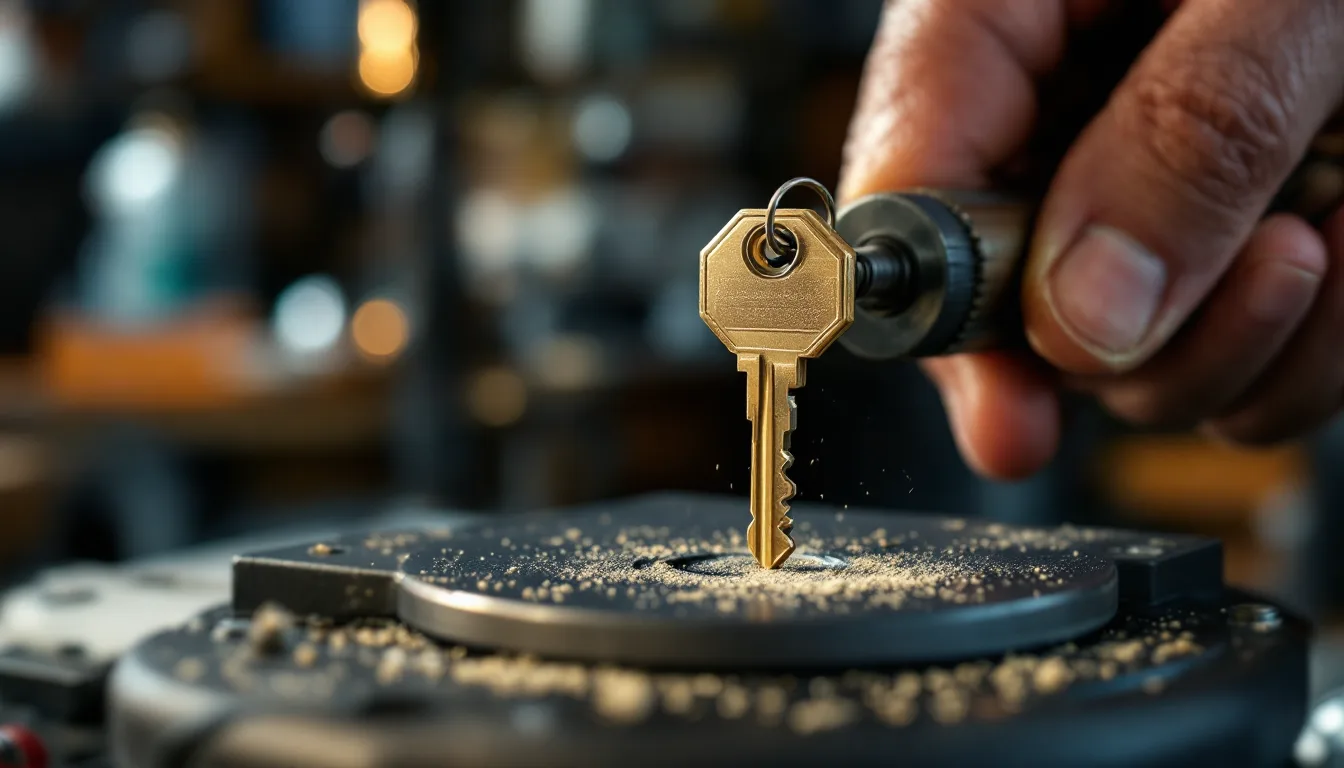
What does key duplication involve, and why does the original matter?
Key duplication sounds simple: you hand over a key, you get another one back. In practice, the quality of the copy depends on the quality of what you start with and on how carefully the new key is cut. A key is a small piece of metal with a series of precise depths. If those depths are off by even a little, the copy may slide into the lock but refuse to turn, or it may turn only when you jiggle it and lean on the door. That is the kind of copy that wears out a lock and ends up broken off inside the cylinder.
The biggest mistake we see is copying a copy. Every generation of duplicate drifts a little from the factory cut. A key made from a key made from a key can be far enough off that it works poorly in the lock it was meant for. Whenever possible, we cut from the original or from a clean first-generation key, and we check the result against the lock before you leave or, on a mobile visit, before we pack up.
If your only key is badly worn, bent, or already a poor copy, tell us. We can often work around that, and in some cases the better answer is to have the lock rekeyed so a fresh, correctly cut key is made to the lock itself. We would rather tell you that up front than hand you a copy that frustrates you every morning.
Which keys can we copy for Altadena homes, apartments, and offices?
Most of what people ask us for falls into a few familiar groups. Here is what we handle on a regular basis, and a plain note on where each one has quirks.
- House key copy and spare house key: standard front-door and back-door keys for single-family homes. This is the most common request, and it is usually quick work.
- Duplicate deadbolt key: deadbolts often use a different keyway from the knob or handle set. We match the right blank to the right lock, and if your entry set and deadbolt are keyed alike, we can tell you whether that is the case by looking at the keys.
- Apartment key copy: unit keys, building entry keys, and shared-area keys. Some buildings restrict who may copy certain keys, and we will explain that honestly if it comes up.
- Office key duplication and commercial key duplication: suite doors, storage rooms, file cabinets, and desks. For businesses with many keys in circulation, we can talk through whether a more organized system would save you trouble.
- Mailbox key duplication: small, flat keys that are easy to lose and easy to cut wrong. Mailbox locks are usually simple to copy, but their condition matters; a worn lock is a reason to look at the lock itself.
- Padlock and gate keys: common on side yards, sheds, and fenced lots. These vary a lot by brand, and we check the stamping and the blank before cutting.
Locked out or need a locksmith now?
We answer around the clock, every day of the year.
Call (213) 577-1366What about high security and restricted key duplication?
Not every key can be copied at a hardware-store kiosk, and that is by design. High security key duplication covers keys with more complex cuts, such as dimple or side-milled profiles, and keys from systems built to resist unauthorized copying. Restricted key duplication is a related but separate idea: the keyway is controlled by the manufacturer, and copies are meant to be made only for the person or organization that is authorized to have them.
What this means for you is that a restricted key may require a card, a signature, or proof of authorization before it can be duplicated, and some can only be ordered through the manufacturer or its channel. We will not pretend otherwise or promise a copy we cannot legally and properly make. Some keys we can cut at the storefront, some we need to order, and a few may only come through the original dealer or key holder. When we do not know until we see the key in hand, we will say so.
A stamp that reads "Do Not Duplicate" on a key is not by itself a lock on the key. Many shops will still copy those keys, and that is a reason not to rely on a stamp for security. If you actually need control over who can make copies, the real solution is a patented or restricted system. Our page on high-security locks explains how those systems work and when they are worth the extra step.
How does key duplication work, step by step?
Whether you come to the storefront or ask for a mobile visit, the process follows the same sequence. Nothing about it is mysterious, and we are happy to explain each part as we go.
- You call (213) 577-1366 and tell us what you need copied: the type of key, the lock it belongs to, and how many copies you want. Someone answers around the clock, so this works late at night or on a holiday too.
- We tell you whether the key looks like a standard copy, a high security key, or a restricted one, and whether we can cut it on the spot, need to order a blank, or need authorization.
- We look at the original. We check for wear, bends, cracks, and the brand stamping, and we choose the matching blank, not a near match.
- We cut the copy and remove the burrs left from cutting. Leftover burrs are a quiet cause of sticky locks, so this step matters.
- We test the new key in the lock it is meant for whenever the lock is available to us, and we adjust if it drags or catches.
- You get the original back along with the copies. If testing shows the lock itself is the problem, we tell you what we found and what your options are, without pushing you into anything.
Locked out or need a locksmith now?
We answer around the clock, every day of the year.
Call (213) 577-1366Can you come to me for mobile key duplication?
Yes, for many keys. Our mobile vans exist so that you do not always have to drive to us, and Altadena sits about 26 miles from our Westwood base. For a house key copy, spare house key, or mailbox key, a mobile locksmith visit can be the practical choice, especially if you are handling several things at once, such as a property manager meeting a contractor or an owner with a full ring of keys to sort out.
To be straightforward about the limits: not every key can be cut well from a van. Some high security keys, restricted keys, and unusual blanks need equipment or inventory that is better at the storefront, or need to be ordered. When you call, we will tell you which situation you are likely in, so you are not waiting around for a visit that cannot finish the job.
If you are locked out and need to get in before you can hand us a key to copy, that is a different service. Our house lockout page covers that, and once you are back inside, we can make the spare copies you should have had in the first place.
What affects the cost of key duplication in Altadena?
We do not quote numbers on a web page because the honest answer depends on the key in your hand. These are the factors that actually move the cost up or down, so you can judge a quote when you hear one.
- Key type: a plain brass house key is the lighter-cost end of the range. High security, restricted, and specialty keys cost more because of the blank, the cutting equipment, and any authorization steps.
- Blank availability: a common blank is on the shelf. An unusual or manufacturer-controlled blank may need to be ordered, and that changes both the cost and the timing.
- Quantity: a few copies of the same key are usually more economical per key than coming back repeatedly for one at a time.
- Condition of the original: a worn or damaged key takes more care, and sometimes a better path is to have the lock rekeyed instead of copying a failing key.
- Where the work happens: cutting at the storefront is generally the more economical route. A mobile visit adds travel and our time on site, which is reasonable when convenience is the point.
- Time of day: because we answer 24 hours a day, a late-night or holiday call may be priced differently than a weekday visit. We will explain that on the phone before we come out.
Locked out or need a locksmith now?
We answer around the clock, every day of the year.
Call (213) 577-1366Key duplication around Altadena: rebuilds, Craftsman hardware, and gated streets
Altadena is not a single kind of place when it comes to keys, and the January 2025 Eaton Fire is a big part of why. The area now has surviving older homes standing near active rebuilding, and West Altadena was hit especially hard. That mix shows up at the lock. On intact blocks in the 91001 ZIP, you will still find original early-1900s locksets on Craftsman bungalows and Janes Village cottages, while newly built or rebuilt homes have modern door hardware with different keyways entirely.
For an older house near the Christmas Tree Lane district on Santa Rosa Avenue, key duplication often means working with vintage hardware. Old keys can be worn from decades of use, and a copy made from a worn original inherits that wear. If you have one key to a Craftsman front door and it has seen better days, we would rather cut a careful copy now than have you wait until it snaps in the lock. If the old lockset has lost its keys entirely or was keyed to someone you no longer know, a lock rekey is the right next step, and we can keep the original character of the hardware.
For rebuilding projects in West Altadena and East Altadena, the key situation is different. During reconstruction, an owner may hand copies of a key to a builder, an inspector, a subcontractor, or a family member helping out. Each copy is one more person who can open the door. Our advice is simple: make only the copies you need, keep track of who has them, and plan to rekey once construction is finished so that any key that went out during the build no longer works. New lock installation on a finished home is the natural time to set that up properly.
La Viña, the gated hillside community at the northwest edge of Altadena, brings its own set of keys: the house keys, plus whatever the gate or entry system requires. We can copy the house and mailbox keys for a La Viña home. If the gate itself needs attention, that belongs under gate lock repair, not a simple key copy, and any access card or code system is managed by whoever runs it.
The climate also matters more than people expect. Altadena's foothill summers run hotter than the basin, and dry Santa Ana winds blow grit off the San Gabriels. Sun and grit are the main wear factors on exterior doors and locks here. A key that goes into a gritty, sun-baked lock every day wears faster, and so does the lock. If your keys are starting to feel rough or stiff in the door, that is often the first sign, and a fresh copy cut from a good original can make the lock behave better.
Locked out or need a locksmith now?
We answer around the clock, every day of the year.
Call (213) 577-1366When is a copy not enough?
Duplicating a key is the right answer when the lock is fine and you simply need more keys. It is the wrong answer in a few situations, and we would rather say so than sell you something that does not solve the problem.
If a key has been lost and you do not know who might have it, copying the spare does nothing about the missing one. The lock still opens for whoever finds it. That is a rekey situation. If you are a landlord or property manager passing keys between tenants, the same logic applies.
If you manage a business or a building with many doors and many people, a pile of individual copies becomes hard to control. A master key system lets different people open different sets of doors with different keys, and you can see exactly who has what. That is a bigger project than duplication, but it is worth knowing about before your key ring gets out of hand.
If your mailbox lock is badly worn or the key no longer turns reliably, a copy will not fix it. The lock itself may need to be replaced. Our mailbox lock replacement page covers that.
Why call Wilshire Lock & Key for duplicate keys?
We have been in business since 1987, and key cutting is among the oldest parts of what a locksmith does. That experience shows up in small ways: knowing when a blank is the wrong one, noticing a worn original before it fails, and being willing to say that a copy will not solve your problem.
We operate from a storefront at 10740 Wilshire Blvd in Westwood and send out mobile service vans. That combination matters for duplication because some keys are easiest to cut in a shop with a full inventory, and some are more convenient to handle at your door. You deal with one company, not a dispatch service that sends whoever happens to be free. David, the owner and lead technician, oversees the work.
One thing worth knowing about any locksmith you hire: California requires locksmith companies to hold a BSIS LCO license, and you should ask any locksmith for that license number before work begins. That is a fair question to put to us as well, and it is a good habit for any service call.
You can reach us at (213) 577-1366 at any hour, any day of the year. If you are not sure whether what you need is duplication or something bigger, call and describe it. Our Altadena locksmith page gives the wider picture of what we do in the area.
Frequently asked questions
Can you make a copy of a key that says "Do Not Duplicate"?
That stamp is not a legal barrier by itself, and many shops will cut those keys anyway. We look at the key itself. If it is a true restricted or patented key, we may need authorization or have to order it through the manufacturer. If it is a standard key with a stamp, we will explain what we can do. If you want real protection against copying, a restricted system is the answer, not a stamp.
How many copies of my house key should I have made?
Enough that you are never stuck, and no more than you can keep track of. For most households that means a spare kept somewhere trustworthy, not under a doormat. Every extra copy is one more key that could be lost, so we suggest making only what you need and rekeying if you ever lose track of one.
Can you copy a deadbolt key if it is different from my doorknob key?
Yes. Deadbolts often use a different keyway than the handle set, so we match the correct blank to each one. If you bring both keys or tell us which lock each belongs to, we can cut a duplicate deadbolt key and check whether your locks are keyed alike.
Do you offer mobile key duplication in Altadena, or do I have to come to you?
We do both. Many standard keys, like house, apartment, and mailbox keys, can be handled by a mobile visit. Some high security or restricted keys need the storefront or a special order. Call (213) 577-1366 and describe the key, and we will tell you which route makes sense.
My key is old and worn, and it sticks in the lock. Should I just copy it?
Not from the worn key if you can avoid it. A copy of a worn key carries the wear forward and may work poorly. If it is the only key you have, we can often cut a usable copy, but the better long-term fix may be rekeying the lock so a fresh key is cut to the lock itself.
Can you duplicate office or commercial keys, including for a business with many employees?
Yes, office key duplication and commercial key duplication are routine work for us. Be aware that some commercial keys are restricted and need authorization. If many people hold keys, ask us about a master key system, which gives you better control than a growing number of loose copies.
Can you copy a mailbox key in Altadena?
In most cases, yes. Mailbox keys are small and easy to cut wrong, so we match the blank carefully. If the mailbox is part of a building managed by someone else, they may control the key, and we will let you know if that affects what we can do.
Is it safe to give copies of my keys to contractors during a rebuild?
It is common, but treat it as temporary access. Give copies only to people who need them, keep a simple list, and plan to rekey once work is finished so that any key that went out no longer opens the door. That is especially worth doing on a home being rebuilt after the Eaton Fire.
Are you a licensed locksmith, and what should I ask before hiring one?
California requires locksmith companies to hold a BSIS LCO license, and you should ask any locksmith for the number before they begin, including us. Also ask who will be doing the work, whether the company has a real storefront, and how the cost is determined before work starts.
More locksmith help in Altadena
Key Duplication near Altadena
Reviewed by David, Owner & Lead Technician, Wilshire Lock & Key — in the locksmith trade since 1987.
Last updated 2026-10-11.